On this page
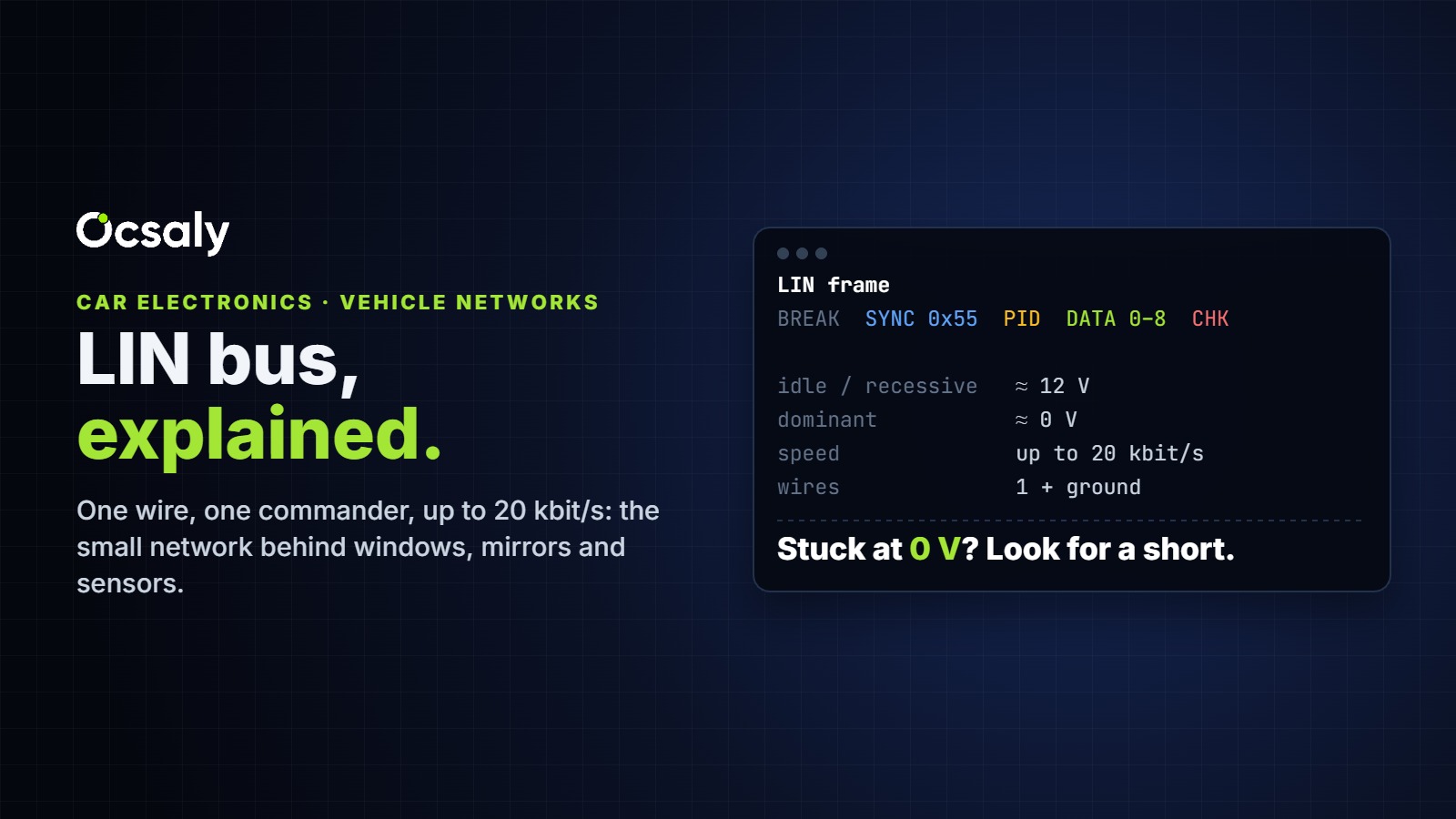
The LIN bus (Local Interconnect Network) is a cheap, single-wire network that cars use for simple, slow devices: window switches, mirrors, seat modules, rain and light sensors, wiper motors, climate flaps, steering wheel buttons and smart alternators. One commander module (traditionally called the master) controls the bus and up to about 15 responder nodes answer when asked. LIN runs at up to 20 kbit/s (19.2 kbit/s is common) over one wire referenced to ground: the line idles at about battery voltage and is pulled to about 0 V for a dominant bit. It is standardised today as ISO 17987. Where CAN connects the important modules to each other, LIN hangs smaller devices off one of those modules.
Why cars use LIN
A car has dozens of small electronic devices that only exchange a few bytes now and then. Giving each one a CAN controller, a transceiver and two twisted wires would be expensive. LIN needs one wire, a simple transceiver and a standard serial interface (UART), so a mirror motor or a rain sensor can be networked for very little cost. A body control module, door module or climate module usually acts as the LIN commander and passes the information on to the CAN network.
How a LIN frame works
The commander decides who talks and when, using a schedule table. Every frame starts with a header from the commander; then either the commander or one responder sends the response.
| Field | Sent by | What it does |
|---|---|---|
| Break | Commander | At least 13 dominant bits: “a new frame starts now” |
| Sync | Commander | The byte 0x55 (alternating bits) so responders can measure the bit rate |
| Protected identifier | Commander | 6-bit frame ID plus 2 parity bits: which data is requested |
| Data | Commander or one responder | 0 to 8 bytes, most often 2, 4 or 8 |
| Checksum | Same node as the data | Classic checksum (data only) in LIN 1.x, enhanced (data plus ID) in LIN 2.x |
Because only the commander starts frames, there are no collisions and no arbitration as on CAN. The frame IDs 0x3C and 0x3D are reserved for diagnostic requests and responses, which is how a scan tool can reach a LIN device through its commander module.
LIN vs CAN
| LIN | CAN (high speed) | |
|---|---|---|
| Wires | 1 (plus ground) | 2 twisted (CAN high, CAN low) |
| Speed | Up to 20 kbit/s | Usually 500 kbit/s |
| Access | Commander polls responders | Any node can send, lowest ID wins |
| Termination | None (pull-up resistors) | 120 Ω at each end, 60 Ω total |
| Typical nodes | Switches, sensors, motors | Engine, gearbox, ABS, airbag, cluster |
| Cost | Very low | Higher |
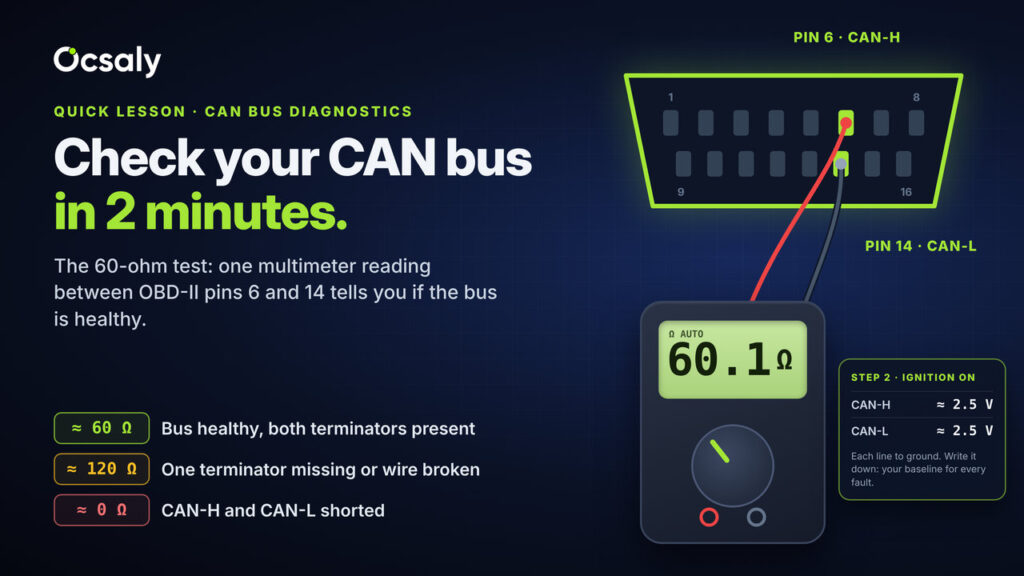
How CAN works at the bit and voltage level is explained in CAN Bus Explained: Voltages, Frames and the 60-Ohm Test.
LIN voltages
The commander holds the line up to battery voltage through a pull-up resistor (about 1 kΩ, with a diode), and responders have weaker pull-ups (about 30 kΩ). A node sends a dominant bit by pulling the line down to near ground.
- Idle (no traffic): about battery voltage, around 12 V with the engine off.
- With traffic, on a multimeter: a slightly lower average, often somewhere between about 9 and 11 V depending on how busy the bus is.
- On an oscilloscope: a clean square wave between about 0 V and battery voltage. Slow, rounded edges are normal for LIN.
How to diagnose a LIN bus fault
Typical symptoms: one switch, mirror or sensor stops working, the commander module stores a “no communication with” code for that device, or several devices on the same LIN line fail together.
- Read codes in the commander module (for example the body or door module). LIN faults are reported there, often naming the device that stopped answering.
- Find the LIN wire in the wiring diagram. It is a single wire, often marked LIN, between the commander and the devices.
- Measure the voltage to ground, ignition on. About battery voltage or a slightly lower average is normal. 0 V means the wire is shorted to ground or a device is holding it low. Exactly battery voltage with no change while you operate the device can mean the commander is not sending, or the wire is open.
- Unplug devices one at a time if the line is stuck low. When the voltage comes back, that device or its wiring is the fault.
- Check each device’s power and ground. A responder without power or ground cannot answer even if the LIN wire is fine.
- Use a scope for intermittent faults or when the voltage looks right but nothing works, to see whether headers are being sent and whether the responder answers.
The same voltage-drop and continuity methods apply as for any wire; see How to Find a Faulty Wire in a Car.
Frequently asked questions
What is the LIN bus used for in cars?
For simple, low-speed devices: window and mirror switches, seat controls, rain and light sensors, wiper motors, climate control flaps, steering wheel buttons, interior lighting and smart alternators or battery sensors on some cars.
What voltage should a LIN bus have?
About battery voltage (around 12 V) when idle, with a slightly lower average on a multimeter when there is traffic. On a scope it switches between about 0 V and battery voltage.
How fast is the LIN bus?
Up to 20 kbit/s. 19.2 kbit/s and 9.6 kbit/s are common in cars.
What is the difference between LIN and CAN?
LIN uses one wire, is much slower and has one commander that polls the other nodes. CAN uses two twisted wires, is much faster and lets any node send, with the lowest ID winning. CAN connects the main modules; LIN connects small devices to one of them.
Does the LIN bus need terminating resistors?
No. Unlike CAN, LIN uses pull-up resistors in the commander and responders instead of 120 Ω terminators.
Learn every network in the car
LIN, CAN, K-line and automotive Ethernet all appear in a modern car. Our Car Electronics & Car Hacking course explains how vehicle networks work, how to measure them and how to capture and decode their messages.