On this page
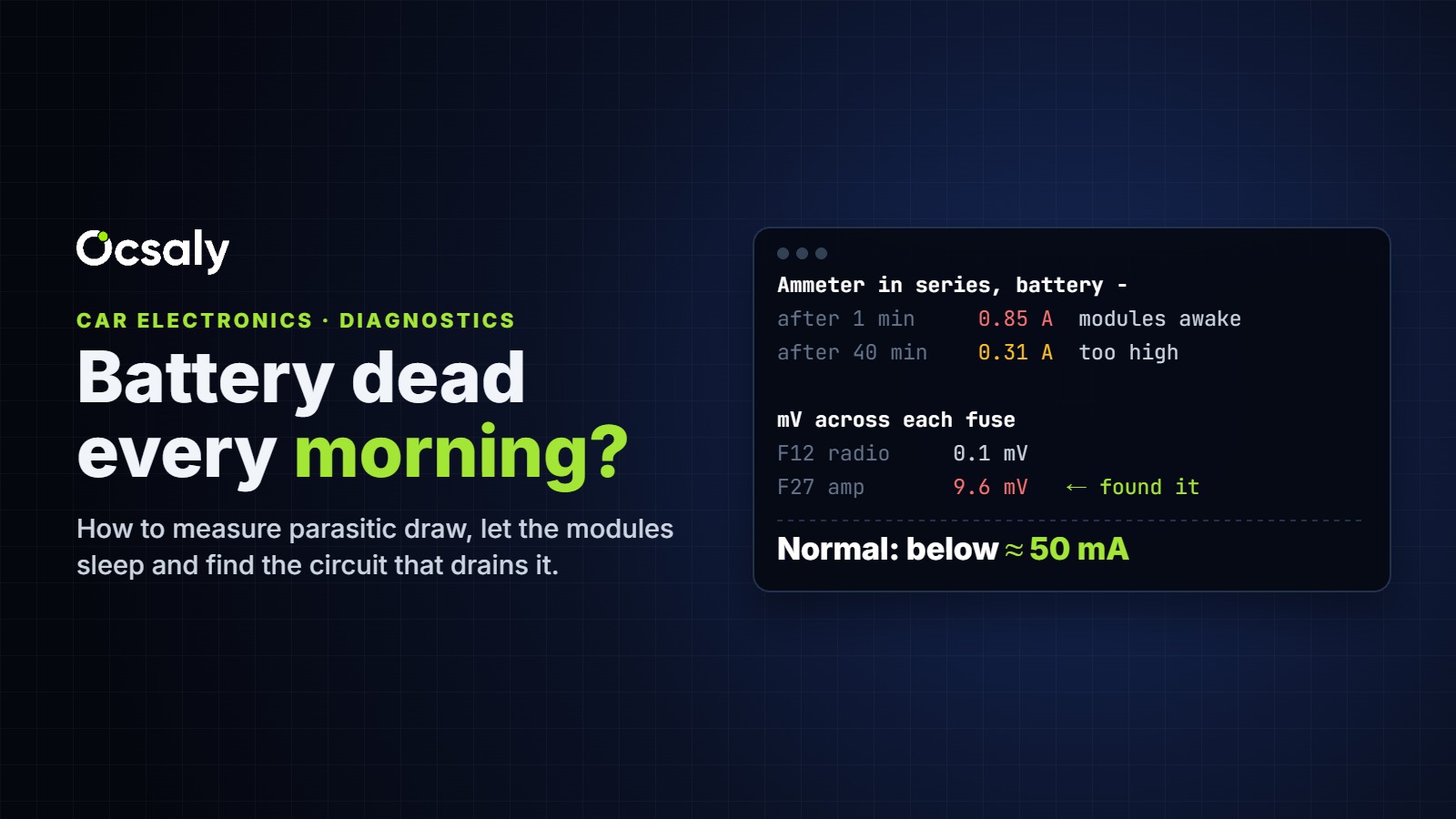
A parasitic battery drain is current the car keeps using after it has been switched off and locked. Every modern car draws a little (clocks, alarm, keyless entry, module memory), but once the modules go to sleep the draw should fall to a few tens of milliamps, typically below about 50 mA (check the manufacturer’s figure for your car). To test it, connect an ammeter in series with the battery negative (or use a low-current DC clamp meter), lock the car, wait 20–60 minutes for the modules to sleep, and read the current. If it is too high, find the circuit by measuring the tiny voltage drop across each fuse or by pulling fuses one at a time.
Drain, bad battery or bad alternator?
Before chasing a drain, rule out the two other usual suspects:
- Battery: charge it fully and have it load-tested or tested with a conductance tester. A battery with a failed cell or low capacity goes flat overnight even with a normal draw.
- Charging: with the engine running, the voltage at the battery should normally be about 13.8–14.7 V (some cars with smart charging vary this on purpose). A weak alternator leaves the battery undercharged, which looks like a drain.
If both are fine and the battery still goes flat after a day or two, measure the parasitic draw.
How much drain is normal?
A battery loses charge in proportion to the current and the time. A draw of 30 mA uses 0.72 Ah a day; a 70 Ah battery that should not go below half charge (35 Ah) lasts about seven weeks. A draw of 300 mA empties that same half in about five days.
| Sleep current | What it means |
|---|---|
| Below about 50 mA | Normal for most modern cars (check the spec) |
| 50–100 mA | Borderline; may cause trouble if the car stands for weeks |
| More than 100 mA | Something is staying awake or a circuit is leaking current |
| Amps | A light, motor, relay or short is on |
Tools you need
- A digital multimeter with a 10 A range, or a DC clamp meter that can read milliamps
- A fused jumper lead, to keep the circuit closed while you connect the meter
- The fuse box layout for your car (in the manual or on the fuse box cover)
Parasitic draw test step by step
- Prepare the car. Fully charge the battery. Switch everything off, remove the key (keep keyless keys far away), close the windows. If you need to reach the fuse box or the battery with doors or the bonnet open, close their latches with a screwdriver so the car thinks they are shut.
- Connect the meter without breaking the circuit. Put the meter on the 10 A range. Connect it between the battery negative post and the disconnected negative cable, with a jumper lead across it while you do so, then remove the jumper. If power is interrupted, many modules wake up and you have to wait for them again. With a clamp meter, just clamp around the negative cable after zeroing it.
- Do not start the car or switch on big loads while the meter is in series: the starter current would blow the meter’s fuse instantly.
- Lock the car and wait. Note the current every few minutes. It is usually high at first and falls in steps as modules go to sleep. Many cars need 20–40 minutes, some up to an hour or more.
- Read the sleep current and compare it with the spec. If it is normal, the problem is more likely the battery, the charging system, or a drain that only happens sometimes (for example when a module fails to sleep after a certain event).
Find the circuit: the fuse voltage drop method
Pulling fuses can wake modules up and hide the fault. A cleaner method is to measure the millivolts across each fuse with the meter on its lowest DC voltage range, touching the two test points on top of the fuse. Current flowing through a fuse makes a tiny voltage drop across it:
- 0.0 mV: no current through that circuit.
- A few tenths of a mV or more: current is flowing. The larger the reading for a given fuse size, the more current.
Fuse manufacturers publish tables that convert the millivolt reading into milliamps for each fuse rating. Even without a table, the fuse with a clearly higher reading than the rest is where to look. Then use the wiring diagram to list everything on that fuse and disconnect devices one by one.
If you prefer the classic method, pull one fuse at a time while watching the ammeter and put each fuse back before pulling the next one. When the current drops, you have found the circuit.
Common causes of battery drain
- Aftermarket devices: radios, amplifiers, dashcams on permanent power, trackers, alarms
- A glovebox, boot or vanity light that stays on
- A module that does not go to sleep and keeps the CAN bus awake (often after water damage or a failed update)
- A sticking relay, for example for a fan, fuel pump or heated rear window
- A leaking diode in the alternator
- USB chargers or accessories in permanently live sockets
- Telematics or keyless entry systems with a fault
When a module keeps the network awake, you can often see it: CAN traffic is still present on the bus long after the car was locked. Measuring CAN voltages or looking at the bus with a scope shows it; the pins are in the OBD2 pinout guide.
Related guides: how to test an alternator, voltage drop test.
Frequently asked questions
What is a normal parasitic draw on a car battery?
Most modern cars settle below about 50 mA once all modules are asleep. Some manufacturers allow a little more; check the figure for your car. Older cars often draw much less.
How long does a car take to go to sleep?
Usually 20 to 40 minutes after locking, sometimes an hour or more on cars with many modules. Opening a door, using the key or disconnecting the battery restarts the timer.
Can a bad alternator drain a battery when the car is off?
Yes. A leaking rectifier diode in the alternator can let current flow back from the battery when the engine is off. The fuse method or disconnecting the alternator’s main cable during the test will show it.
Can I do a parasitic draw test with a clamp meter?
Yes, if the clamp meter can measure DC current in the milliamp range. It is easier because you do not have to disconnect the battery, which keeps the modules asleep.
Why does my reading jump up and down during the test?
Modules wake up briefly to check keys, alarms or the network, then go back to sleep. Short peaks are normal; judge the current when it has been stable for several minutes.
Learn electrical diagnosis properly
Battery drains, voltage drops and network faults are the bread and butter of car electrical work. Our Car Electronics & Car Hacking course teaches how car electrical systems work and how to test them step by step, and the OCAUTO certification track covers parasitic draw and power distribution in depth.