On this page
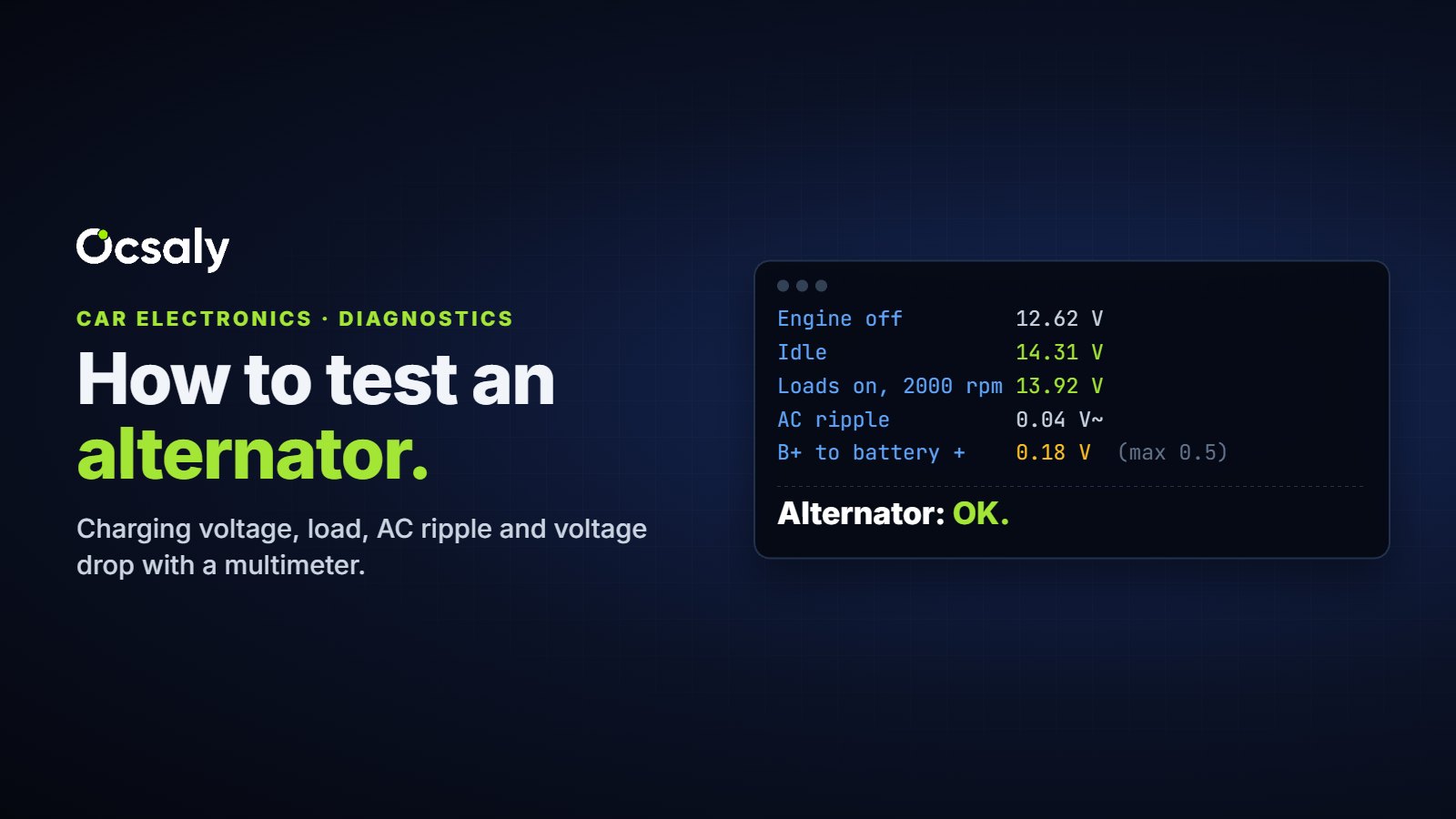
To test an alternator with a multimeter, measure the battery voltage with the engine off (about 12.4 to 12.7 V), then start the engine and measure again. A working alternator raises the voltage to about 13.8 to 14.8 V. Then switch on headlights, blower and rear demister: the voltage should stay above roughly 13.2 V. Finally check AC ripple (below about 0.5 V AC) for failed diodes and voltage drop on the charge and ground cables.
These five tests take about 10 minutes and tell you whether the alternator, the battery or the wiring is the problem.
What you need
- A digital multimeter (any auto-ranging meter is fine)
- Safety glasses, and the engine bay clear of loose clothing
- Optional: a clamp meter for current, a battery tester
Test 1: battery voltage, engine off
Measure across the battery terminals with the engine off and everything switched off for at least an hour.
| Reading | Battery state |
|---|---|
| 12.6 to 12.7 V | Fully charged |
| 12.4 V | About 75 % |
| 12.2 V | About 50 % |
| Below 12.0 V | Discharged: charge and test the battery before judging the alternator |
A flat battery makes the alternator look weak, so start with a charged battery. If the battery goes flat overnight, also do a parasitic drain test.
Test 2: charging voltage, engine running
Start the engine, let it idle and measure at the battery terminals.
| Reading | Meaning |
|---|---|
| 13.8 to 14.8 V | Normal charging |
| Below about 13.2 V | Undercharging: alternator, belt, wiring or regulator |
| Above about 15 V | Overcharging: regulator fault, can damage the battery and electronics |
| Same as engine off | No charging at all |
Smart alternators. Many cars from about 2008 onward control the alternator through the engine computer (often via LIN bus or a PWM signal). The voltage may sit at 12.5 to 13 V when cruising and rise to 15 V during braking. A low reading at idle is not always a fault on these cars. Check the manufacturer’s data or switch on electrical loads, which usually makes the system charge.
Test 3: load test
With the engine running at about 2000 rpm, switch on the headlights on high beam, the blower on full and the rear demister. Measure at the battery again.
- Stays above about 13.2 V: the alternator keeps up with the load.
- Drops toward battery voltage: the alternator is weak, the belt slips, or a connection is bad.
A squealing belt when loads switch on points to belt tension or a worn belt, not the alternator itself.
Test 4: AC ripple (diode test)
An alternator produces AC that is rectified to DC by diodes. A failed diode lets AC ripple through, which causes weak charging, a whining noise in the audio, and strange electronic faults.
- Set the meter to AC volts (V~).
- With the engine running and loads on, measure across the battery.
- Below about 0.5 V AC is acceptable; good alternators are usually well below 0.1 V AC. Higher readings point to a failed diode.
Test 5: voltage drop on the cables
A perfect alternator cannot charge through a corroded cable. Measure the drop on each side while it charges under load. The method is explained in detail in our voltage drop test guide.
| Measurement | Probe positions | Maximum |
|---|---|---|
| Charge side | Alternator B+ terminal and battery positive post | About 0.5 V (good systems 0.2 to 0.3 V) |
| Ground side | Alternator case and battery negative post | About 0.2 V |
A high reading means the cable, a fuse link or a connection on that side is the fault, not the alternator.
Reading the results together
| Results | Most likely fault |
|---|---|
| Low voltage, low drop, low ripple | Alternator or regulator, or a smart charging strategy |
| Low voltage, high drop on charge cable | Cable, fuse link or terminal |
| Normal voltage, high AC ripple | Failed diode in the alternator |
| High voltage over 15 V | Regulator fault |
| Normal results but flat battery | Battery fault or parasitic drain |
Symptoms of a failing alternator
- Battery warning light on the dash, or flickering
- Dim or pulsing headlights, especially at idle
- Whining noise that changes with engine speed
- Repeated flat battery even with a new battery
- Electrical faults and many fault codes after a short drive
- Burning smell from a slipping belt or overheating alternator
Frequently asked questions
What voltage should an alternator put out?
Usually 13.8 to 14.8 V measured at the battery with the engine running. Smart charging systems can show lower values while cruising and higher values while braking.
Can I test an alternator without removing it?
Yes. All five tests in this guide are done on the car with a multimeter. A bench test is only needed to confirm a fault before replacement.
Will a bad alternator drain the battery when the car is off?
It can. A failed diode can let current leak back through the alternator. A parasitic drain test with the alternator connector unplugged confirms it.
Can a bad battery make the alternator look faulty?
Yes. A battery with a shorted cell or very low charge pulls the voltage down. Charge and test the battery before condemning the alternator.
How long does an alternator last?
Often 100,000 to 200,000 km, but heat, water and electrical overloads shorten its life.
Learn car electrical diagnosis properly
Charging problems are where wiring, sensors and the engine computer meet. Our Car Electronics and Car Hacking course teaches multimeter and oscilloscope testing, voltage drop, and how modern cars control their electrical systems over the CAN and LIN networks.