
Operational Dominance
The Full-Spectrum Certification Track (Phases A-C)
Intelligence & Architecture
The Foundation. Before you strike, you must see. Master the physics of the network, dissect the OSI model, and execute stealth target acquisition with Nmap and Wireshark.
Ethical Hacking & Prof Bug Bounty
The Arsenal. Manual hacking is too slow. Transition to Systems Operations and master the "Builder/Breaker" trilogy: Bash, Python, and PowerShell to automate your kill chain.

Binary Engineering & Dev
The Apex. Leave the script kiddies behind. Enter the world of Memory Corruption. Use C and Assembly to reverse engineer binaries and hand-craft custom shellcode.
Penetration Testing Program
$199.00 One-time payment
- Reconnaissance and intelligence
- Scripting and exploitation
- Binary exploitation
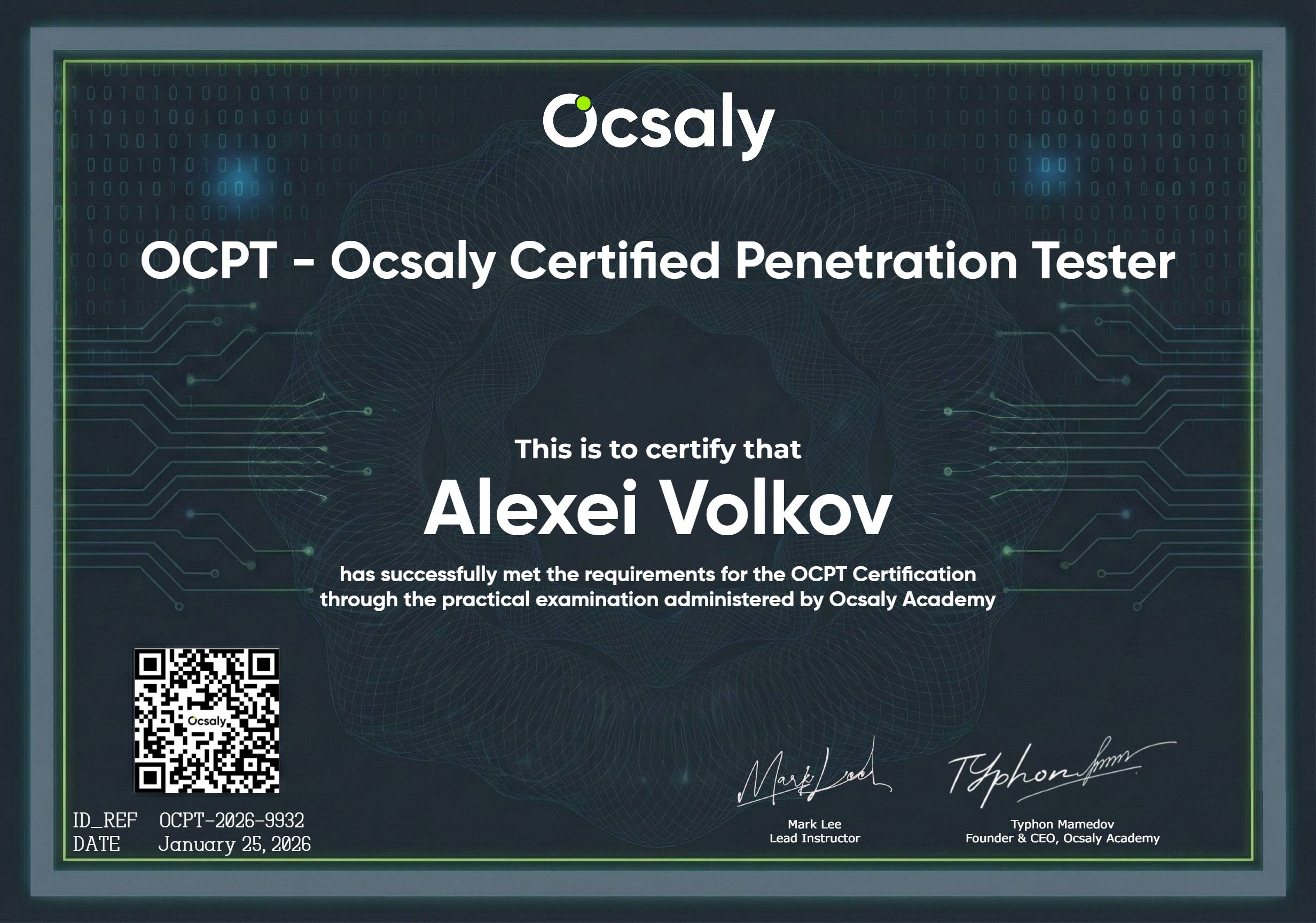
Practical assessment and a verifiable Ocsaly credential upon passing.
One payment covers all 24 published courses, every course update, and all future courses as they’re released.
Operational Inventory & Certification
OCPT-A: RECONNAISSANCE & INTEL
57 hoursView details
CORES: CPU Architecture, x86/x64 Logic, Memory Registers (EAX, ESP, EIP), Ghidra Reverse Engineering, Binary Analysis, Logic Gates.
NETWORK: OSI Model Dissection, TCP/IP Handshakes, ICMP, DNS, SMB Enumeration, SMTP, FTP Dissection.
TOOLKIT: Nmap (Stealth Scanning, NSE Scripting), Wireshark (Packet Dissection, PCAP Analysis), TCPDump, Netcat, Google Dorking, OSINT Frameworks.
OCPT-B: WEAPONIZATION & SCRIPTING
21+ hoursView details
SYSTEMS: Linux Kernel, Bash Scripting, Cron Jobs, Permissions, SSH/RDP Tunneling, Privilege Escalation Foundations.
AUTOMATION: Python Offensive Dev, PowerShell Empire, Socket Programming, Custom Exploit Wrappers, Multi-Threading Scanners, API Interception.
CRYPTO: Hash Cracking (John the Ripper, Hashcat), Rainbow Tables, MD5, SHA-256, Bcrypt, Salt Dissection, Brute-Forcing Workflows.
OCPT-C: BINARY EXPLOITATION
20+ hoursView details
DEVELOPMENT: C Programming, x86 Assembly (ASM), Compiled Binary Reversing, Stack vs Heap Analysis, Endianness.
EXPLOITS: Buffer Overflows, Fuzzing, Offset Calculation, Bad Character Filtering, JMP ESP, EIP Overwrite, NOP Sleds.
ENGINEERING: Shellcode Development, Payload Injection, Reverse Shells, Bypassing ASLR/DEP Foundations, Malware Logic & Persistence.
OCPT PRACTITIONER CERTIFICATION & EXAM
View details
EXAM: 24-Hour Hands-On Practical Examination in Private Lab Environment. Full Operational Report Required.
CREDENTIAL: Verifiable Digital ID, Permanent Record of Practitioner Status, High-Resolution PDF/Physical Credential Access.
VALIDATION: Cryptographically Signed Verification Code for Employer Authentication.
Courses in this track
- OCPT-A | Master the Ethical Hacking
- OCPT-B | Tactical Scripting & Cryptography
- OCPT-C | Binary Exploitation & Engineering
- Ethical Hacking Training
- Network Reconnaissance Architecture: Advanced Nmap Scans
- Advanced Penetration Testing with Metasploit
- Assembly & Shellcode Development | Ethical Hacking
- Wireshark for Packet Analysis
Articles for this track
- TCP Header Structure Explained: Ports, Sequence Numbers, Flags, Window and Options
- Linux Directory Structure Explained: What Every Folder in / Is For
- Nmap Scan Types Explained: SYN, Connect, UDP, ACK, FIN, Xmas and Idle Scans
- GPRS vs EDGE: Differences, Speeds, Modulation and Network Elements Explained
- LTE Network Architecture Explained: eNodeB, MME, S-GW, P-GW, HSS and Interfaces
- Linux Pipes and Bash Redirection Explained: |, >, >>, <, 2>&1 and tee
- TShark Tutorial: Capture and Display Filters, Field Output and TShark vs tcpdump
- HLR and VLR in GSM Explained: Roles, Location Updates, AuC and EIR
- Nmap OS Detection Explained: nmap -O, Accuracy Tips and Reading the Results
- execve System Call Explained: How Linux Runs Programs (C and Assembly Examples)
- Linux top Command Explained: Load Average, CPU States, Memory and Useful Keys
- ps aux Command Explained: Columns, STAT Codes and Useful Examples
- Process Injection Explained: Techniques, MITRE T1055 and How to Detect It
- How to Change a MAC Address on Linux and Windows (and Why MAC Filtering Is Not Security)
- GNU Radio Tutorial: Build an AM Receiver With No SDR Hardware
- HackRF One vs Flipper Zero: Which One Should You Learn Radio With?
- Stack Buffer Overflow Explained: How It Works and the Protections That Stop It
- Wireshark Filters Cheat Sheet: Display and Capture Filters Explained [Interactive Lab]
- x86-64 Registers and Assembly Explained: Cheat Sheet for Beginners [CPU Simulator]
- Linux File Permissions Explained: chmod 755, 644 and More [chmod Calculator]
- Nmap NSE Scripts: Categories, Useful Scripts and How to Run Them
- Nmap Cheat Sheet: Scan Types, Port States and Commands Explained [Interactive Lab]
- A new Go-based ransomware is active
- Analysis of Suspected Malware Linked to APT-Q-27 Targeting Financial Institutions