On this page
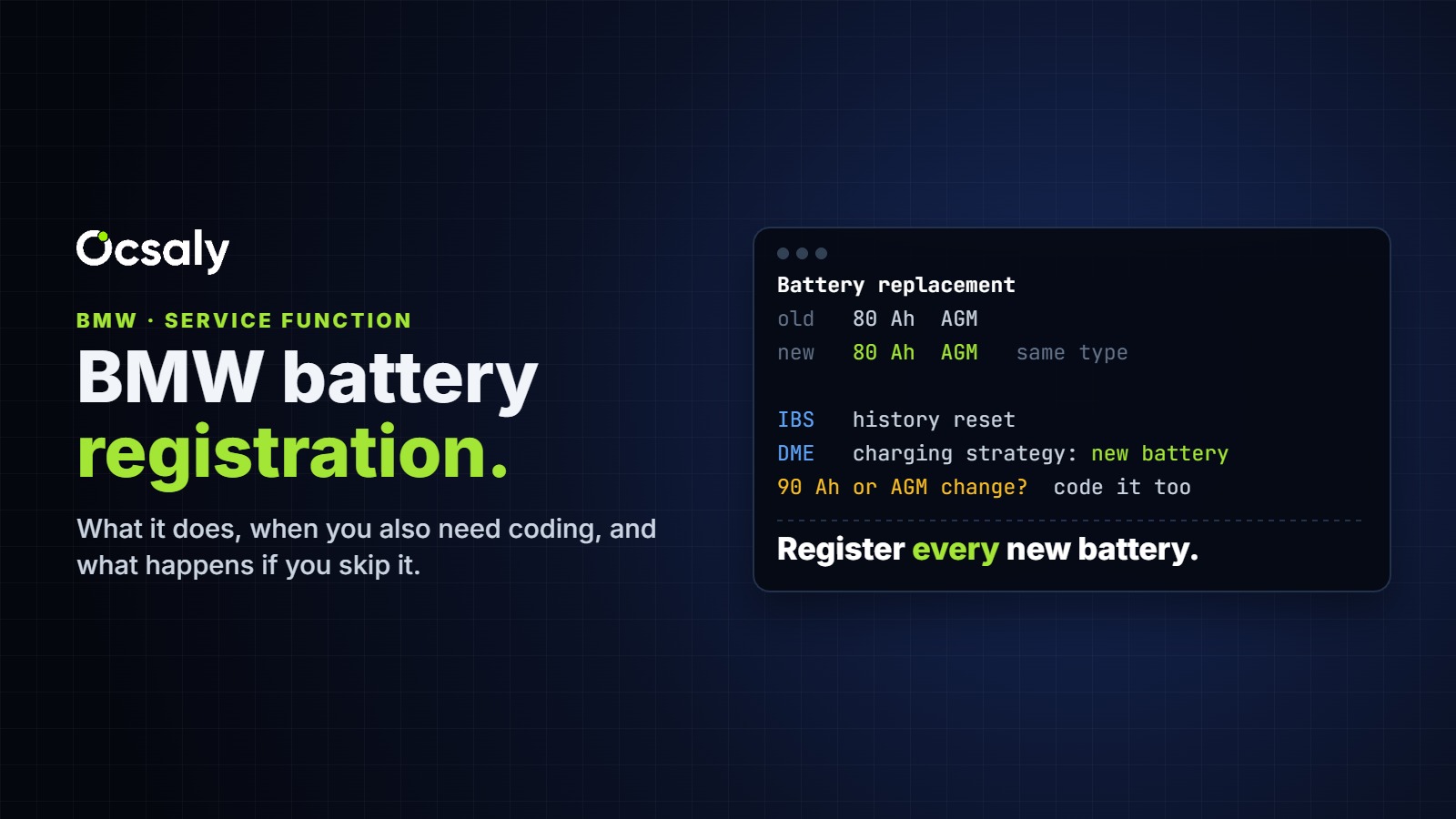
BMW battery registration tells the car’s power management that a new battery has been fitted. BMWs with an intelligent battery sensor (IBS) keep a history of the battery’s age and condition and slowly raise the charging voltage as the battery wears. If you fit a new battery and do not register it, the car keeps charging it as if it were the old, worn one, which overcharges it and shortens its life, and functions such as auto start-stop may stay disabled. If the new battery has a different capacity or type (for example 80 Ah to 90 Ah, or a standard battery to AGM), the change must also be coded into the car. Registration takes a few minutes with ISTA, BimmerLink, Carly or a good multi-brand scan tool.
Which BMWs need battery registration
Practically every BMW and MINI with an IBS, which covers most models from the mid-2000s onward: the E60/E61 5 Series, E90-series 3 Series and later, all F-series and all G-series cars. You can recognise the IBS as a small module clipped onto the battery’s negative terminal. Older models without an IBS, such as the E46, do not need it.
What the IBS and power management do
The IBS measures battery voltage, current and temperature all the time, including while the car is parked. The engine computer or power management module uses those values to work out the battery’s state of charge and state of health, and from that decides how hard the alternator charges and how many consumers it can switch off when the battery is low.
Registration resets that history so the car starts learning the new battery from zero. Without it, the system still applies the charging strategy it calculated for the old battery.
Registration vs coding
| Situation | What to do |
|---|---|
| Same capacity, same type (for example 80 Ah AGM to 80 Ah AGM) | Register the battery |
| Different capacity (for example 70 Ah to 80 Ah) | Code the new capacity, then register |
| Different technology (standard flooded or EFB to AGM, or the reverse) | Code the new type, then register |
The capacity (Ah) and technology (AGM, EFB or standard) are printed on the battery label. The car stores the original battery in its vehicle data, so a change has to be written there for the charging voltage to suit the new battery. AGM batteries in particular need a different charging profile.
How to register a BMW battery
The exact menus differ between tools, but the process is the same:
- Fit the battery correctly. Most BMWs have it in the boot. Connect the IBS to the negative terminal and the vent tube if the battery has one. Note the new battery’s capacity, type and, if your tool asks, its serial number.
- Connect the tool. Ignition on, engine off. Keep a charger or a stable power supply connected if you also have to code, because coding with a sagging battery can corrupt a module.
- Open the battery function. It is called “register battery”, “battery replacement” or “battery registration” depending on the tool. ISTA (BMW’s dealer software) guides you through it as a service function.
- Choose “same capacity and type” to register, or enter the new capacity and type if they changed. Tools that support coding write the new value and then register.
- Confirm and check. Clear any power management codes, switch the ignition off, lock the car and let it sleep. Auto start-stop may need a few drives before the system trusts the new battery’s charge level.
Tools that can do it: ISTA with an ENET or K+DCAN cable, BimmerLink (registration) and BimmerCode (coding) with a compatible OBD adapter, Carly, and most mid-range scan tools from brands such as Autel, Launch and Foxwell that list BMW service functions. Check that the tool supports your exact model before buying it. ENET and K+DCAN cables use different pins on the OBD port, explained in the OBD2 pinout guide.
What happens if you skip registration
- The car overcharges the new battery, which can shorten its life considerably, especially AGM batteries.
- Auto start-stop may not work.
- Power management may switch off comfort consumers early or store battery codes.
- If the capacity or type was changed without coding, the charging voltage is wrong for the battery from day one.
Battery problems that registration will not fix
If a new, registered battery still goes flat, the cause is usually a parasitic drain (a module that does not go to sleep), a weak alternator, or a bad IBS or ground connection. BMWs are sensitive to these because of the many modules that wake up on the network. Measure the sleep current with an ammeter after the car has gone to sleep, and use voltage drop tests on the charging cables, as shown in How to Find a Faulty Wire in a Car.
Frequently asked questions
Do I really need to register a new battery on my BMW?
Yes, on any BMW with an IBS sensor. Without registration the car keeps charging the new battery as if it were the old, worn one, which overcharges it and shortens its life.
Can I register a BMW battery myself?
Yes. ISTA, BimmerLink, Carly and many mid-range scan tools can register a battery. Coding a different capacity or type needs a tool that supports BMW coding.
What happens if I fit a bigger battery without coding it?
The car still charges it with the profile for the original capacity. It will usually work, but the charging is not optimal and the battery may not reach a full charge or may age faster. Code the new capacity, then register.
Can I replace a standard battery with an AGM battery in a BMW?
Yes, if the car is coded for AGM. AGM batteries need a different charging voltage, so the type must be changed in the vehicle data and the battery registered.
How long does BMW battery registration take?
A few minutes with a supported tool. Coding a capacity or type change takes a little longer and should be done with a battery charger connected.
Learn how modern car electronics really work
Battery registration, power management and coding all happen over the car’s networks. Our Car Electronics & Car Hacking course covers charging systems, wiring, diagnostics and how modules communicate, so you understand what the tools do behind the menu.