
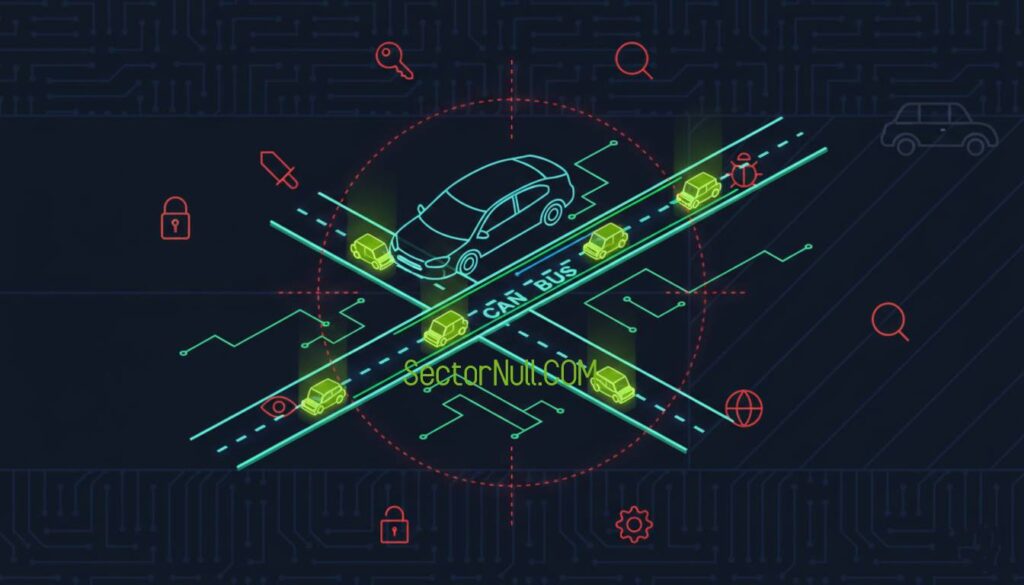
Welcome everyone to Ocsaly. Today we are diving into the black box of vehicle communication. If you want to master automotive electronics or security, you have to stop thinking of a car as a mechanical machine and start seeing it for what it truly is: a high speed local area network on wheels.
In this chapter, we are breaking down the can bus communication protocol. Think of a bus as a literal highway. The packets of data are the cars on that highway, carrying instructions from one controller to another. Now, if you are working on a vintage project, something pre-2000, don’t be surprised if you find nothing but a mess of individual wires. But anything modern is going to have hundreds of sensors screaming at each other over these digital lines every millisecond.
Every manufacturer, whether it is BMW, Toyota, or Ford, gets to play architect. They decide which highway makes the most sense for their specific features. However, there is one universal truth in our world: the can bus.
The Can Protocol: Your Front Door to Automotive Hacking
Regardless of the brand, you will always find the controller area network can bus at the OBD-II connector. That is our front door. But don’t let that fool you into thinking it is easy. Just because the door is in the same place does not mean the language inside is the same. The packets, the actual data, are not standardized. An unlock door command on a Volkswagen looks nothing like one on a Chrysler. That is where our job as tuners and hackers really begins.
We also have to respect the priority of the can network protocol. You are going to see different speeds of bus lines. High speed lines are reserved for the critical stuff like RPM management, timing, and braking. You do not want a delay when the ABS needs to kick in. Then, you have your mid to low speed lines for the comfort features like your AC, your heated seats, or your door locks. Before you even plug in your interface, you need to know the terrain of the specific vehicle you are sitting in.
Technical Deep Dive: Can and Can FD
To understand the can bus protocol, we have to look at the physical layer. In a controller area network bus, that means two wires: CAN High and CAN Low. These wires are twisted together for a very specific reason called differential signaling. This setup allows the can protocol communication to survive the massive electromagnetic noise generated by the ignition coils and alternators.
If you are building your own tools, you are likely familiar with hardware like the mcp2515 stand alone CAN controller. When paired with a transceiver like the mcp2551 or the sn65hvd230 for 3.3V systems, you can begin to sniff this traffic.
We also need to discuss the evolution of this technology: can fd (Flexible Data-Rate). When comparing can and can fd, the main difference is speed and payload size. While a standard can a bus frame is limited to 8 bytes of data, can fd allows for up to 64 bytes and much higher bit rates. Understanding the difference between can can fd architectures is essential as more modern vehicles move toward these faster standards.
The Anatomy of the Controller Area Network Protocol
Every single packet follows a strict anatomy. It starts with an Arbitration Identifier. This ID is the most important part for a hacker because it tells the network what the message is. A critical rule in the canbus world is that the lower the ID number, the higher the priority. Following the ID, you get the Data Length Code and the Data Field. Those 8 bytes are the keys to the kingdom. One bit might represent your brake pedal position while the next byte tells you the exact temperature of the transmission fluid.
Conclusion: Mastering the Can Bus
We have established that the modern vehicle is a sophisticated, distributed computer system. We have identified the entrada point and we now understand how the can bus communication protocol keeps the car functioning safely.
Most importantly, we have seen that while the physical wires of a controller area network can bus are standardized, the logic is often proprietary. Mastering the can bus is not about memorizing one manual. It is about learning the patterns of the digital highway so you can decode any vehicle you encounter.
Your Next Mission: Start Listening
Your first step in the lab is simple: Listen. Before you try to talk to the car or inject packets, you must learn to listen to the constant chatter of the canbus. In our next session, we are going to plug in our mcp2515 interfaces, pull up our terminals, and start sniffing live traffic. We will watch those 8 bytes of data change in real time as we interact with the vehicle. Get your laptops ready, ensure your drivers are installed, and I will see you in the next chapter.
Class dismissed.