On this page
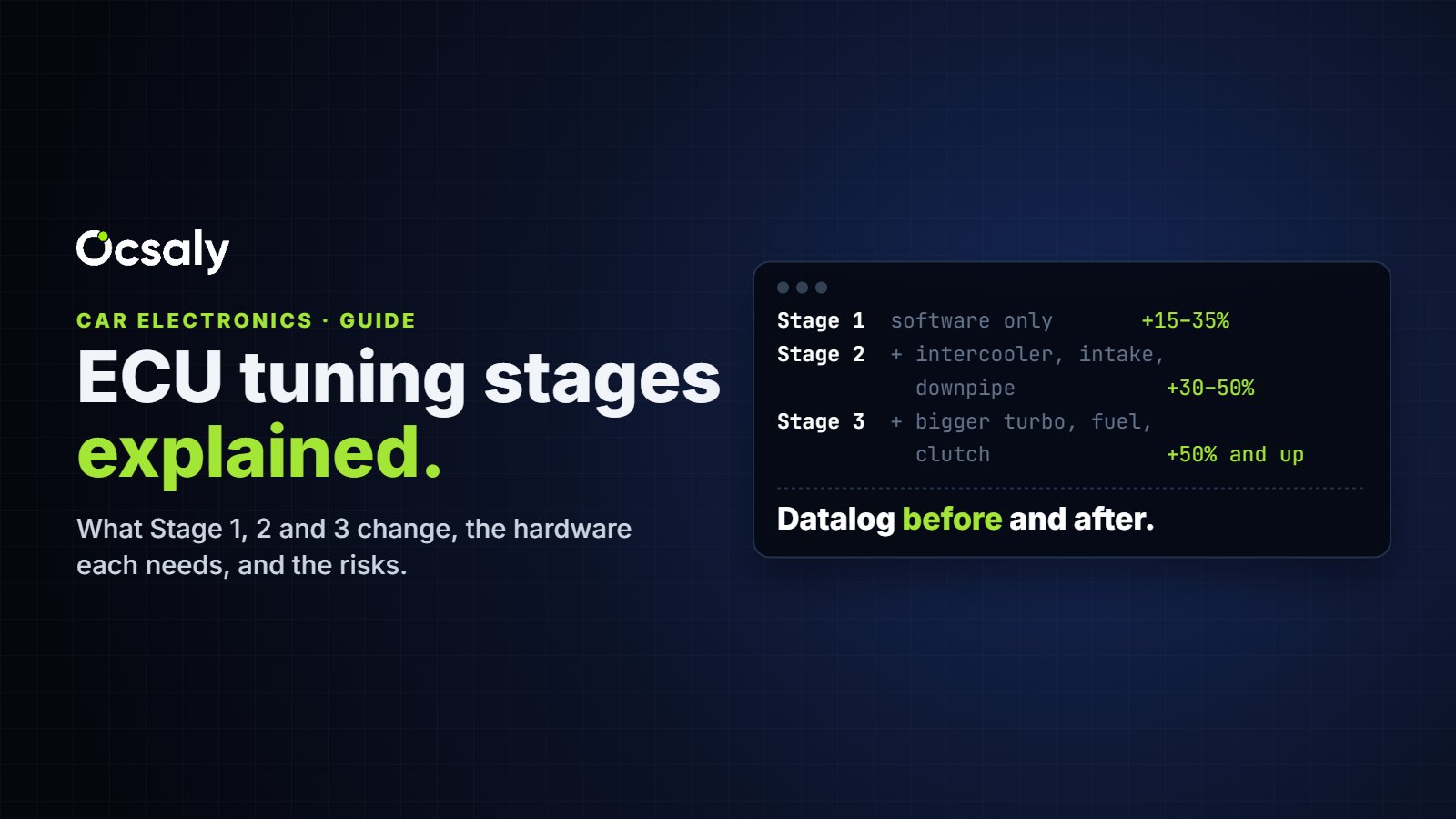
Car tuning stages describe how far a car has been modified. Stage 1 is a software remap of the engine ECU on standard parts. Stage 2 is a remap written for supporting “breathing” parts such as an intercooler, intake and downpipe. Stage 3 adds a bigger turbo (or supercharger) with the fuel system and drivetrain to match. Stage 4 is a fully built engine: internals, turbo, fuel and gearbox, calibrated on a dyno. There is no official standard, so always ask a tuner exactly what is included in their stage.
This guide walks through every stage the way we teach it: what changes inside the ECU, which parts each stage needs, realistic gains for turbo and non-turbo engines, what breaks first, and how to check a tune with your own datalogs.
The four tuning stages at a glance
| Stage | Hardware | Software | Typical gain, turbo petrol or diesel | Typical gain, non-turbo |
|---|---|---|---|---|
| Stage 1 | Standard | Remap of boost, fuel, ignition and torque limits | About 15 to 35% | About 5 to 10% |
| Stage 2 | Intercooler, intake, downpipe or exhaust, sometimes fuel pump | Remap written for those parts | About 30 to 50% | Small, unless camshafts or intake change |
| Stage 3 | Larger turbo or supercharger, injectors, fuel pump, clutch, cooling | Custom calibration on a dyno | 50% and more | Forced induction conversion |
| Stage 4 | Built engine: forged pistons and rods, head work, big turbo, gearbox | Full custom calibration, often a standalone ECU | 100% and more | Engine build or forced induction |
Each stage builds on the one below it. The software is rewritten at every step, because the ECU has to be told about the new parts.
Turbo engines gain the most from software alone, because the remap can ask the turbo for more boost. A naturally aspirated engine has no boost to raise, so a Stage 1 file can only optimise ignition timing, fuel and the rev limit, and the gain is small.
What a remap actually changes inside the ECU
The engine ECU decides how much fuel to inject, when to fire the spark and how much boost to make by looking up values in tables called maps. Every stage is, at its core, an edit of these tables:
- Torque request and torque limiters: the maximum torque the ECU allows in each gear and at each engine speed. Factory limits are often set well below what the engine can take.
- Boost target (turbo engines): how much pressure the turbo is asked to make, and the wastegate or VGT control that delivers it.
- Fuel: the target air-fuel ratio (lambda) on petrol engines, and injection quantity, timing and rail pressure on diesels.
- Ignition timing (petrol): how early the spark fires. More advance makes more power until the engine starts to knock.
- Protection maps: limits for exhaust gas temperature, smoke (diesel) and component temperatures.
If you want to see these tables for yourself, our ECU map training guide shows how to read the axes, the zones and the interpolation the ECU uses.
Stage 1: software on standard parts
A Stage 1 remap keeps the car standard on the outside. The file raises boost and torque within what the original turbo, intercooler, fuel system and clutch can handle. On a modern turbo diesel or turbo petrol this is the best value modification you can make.
- Parts needed: none. The engine must be healthy.
- Typical gain: 15 to 35% on turbo engines, 5 to 10% on non-turbo engines.
- What breaks first: the clutch on manual cars with a big torque increase, and tired ignition coils and plugs on petrol engines.
- Fuel: many petrol Stage 1 files are written for 98 RON. On 95 the knock control pulls timing and you lose part of the gain.
Want to estimate your own number before paying for a map? Use our Stage 1 horsepower gain calculator.
Stage 2: let the engine breathe
At Stage 2 the limit is heat and airflow, not software. A larger intercooler keeps the intake air cooler and denser, a less restrictive intake and downpipe lower the pumping losses, and the map is rewritten to use that headroom with more boost and more timing.
- Parts needed: front-mount or upgraded intercooler, intake, downpipe and often a cat-back exhaust. Some engines also need a higher-flow fuel pump.
- Typical gain: 30 to 50% over stock on turbo engines.
- What breaks first: the clutch, then the stock turbo if the file pushes it outside its efficient range.
- Watch out: parts that remove the catalytic converter or particulate filter make the car fail its road inspection in the EU, UK, US and most other countries.
Stage 3: a bigger turbo and everything around it
Stage 3 usually means a larger turbo or a supercharger. Everything around it has to follow: injectors and fuel pump to supply more fuel, a clutch rated for the torque, better cooling, and often a stronger gearbox. Because every combination of parts is different, there is no off-the-shelf file. The car is calibrated individually, ideally on a dynamometer, while the tuner watches knock, lambda and exhaust temperature.
Stage 4: a fully built engine
Stage 4 is where the engine itself is rebuilt for power: forged pistons and connecting rods, a ported head, upgraded valve springs, a large turbo, a high-capacity fuel system and a gearbox that can take it. Many Stage 4 cars run a standalone ECU, because the factory ECU cannot control the new hardware or cannot be calibrated freely enough. These cars are expensive, need more maintenance and are usually built for the track or drag strip.
Before any stage: the health check
Tuning a sick engine makes the problem worse. Before any remap we always:
- Read fault codes with a diagnostic tool and fix anything stored or pending.
- Datalog a full-throttle pull on the stock map: boost against target, lambda, ignition timing, knock corrections, intake air temperature and, on diesels, exhaust temperature.
- Check for boost leaks with a smoke or pressure test.
- Check the basics: coils, plugs, injectors, clutch slip and the condition of the wiring and connectors. A bad ground or a corroded plug gives strange readings that look like tuning problems. Our guide to finding a faulty wire in a car shows the voltage-drop test we use.
How a professional remap is done
- Read the ECU and keep the original file. Through the OBD-II port with a flash tool, or on the bench in boot mode when the ECU is locked. Store the original safely: it is your way back.
- Edit the maps in a map editor, or load a tested file made for that exact ECU hardware and software version.
- Write the file and correct the checksums. A wrong checksum can leave the ECU unable to start the engine.
- Datalog and verify. Record knock, ignition timing, boost against target, lambda and intake temperature. Adjust until everything is safe, ideally on a dyno.
Which stage is right for your car?
- Daily driver, standard car: Stage 1. Best gain for the money, no parts, reversible.
- Daily driver with a track day now and then: Stage 2, with a better intercooler first. Heat soak is what kills consistency on track.
- Weekend or project car: Stage 3, with a budget for clutch, cooling and a dyno session.
- Dedicated track or drag car: Stage 4, and plan for more maintenance.
Risks and costs to consider
- More torque means more wear on the clutch, gearbox, driveshafts and turbo.
- The manufacturer can refuse warranty claims on a tuned engine. Many ECUs record a flash counter.
- Insurers usually expect you to declare a remap.
- Fuel consumption can drop slightly at steady speed but usually rises if you use the extra power.
Frequently asked questions
What is Stage 1 tuning?
Stage 1 is a software remap of the engine ECU on standard hardware. It raises boost, fuel and torque limits within what the factory turbo, intercooler, fuel system and clutch can handle, typically adding 15 to 35% on turbo engines.
What is the difference between Stage 1 and Stage 2?
Stage 1 is software only on standard parts. Stage 2 adds supporting parts such as a larger intercooler, intake and downpipe, and uses a map written for them, so it can safely run more boost and power.
What does Stage 3 tuning include?
Stage 3 usually means a larger turbo or a supercharger together with bigger injectors, a fuel pump, a stronger clutch and better cooling, calibrated individually on a dyno.
Is there a Stage 4?
Yes. Stage 4 normally means a fully built engine with forged internals, a large turbo, a high-capacity fuel system and often a standalone ECU. Tuners use the name differently, so always ask what is included.
Is Stage 1 tuning safe?
A well-written Stage 1 on a healthy engine is generally safe because it stays within the margins of the standard hardware. Problems come from aggressive files, poor fuel, worn parts and skipping the datalog check.
Can a remap be reversed?
Yes, if the original file was saved. It can be written back to the ECU, although many ECUs keep a flash counter that shows the ECU has been programmed.
Learn to read, modify and test ECUs yourself
Every stage starts with the same skill: connecting to the ECU, reading its data and understanding what the car’s electronics are doing. That is what our Car Electronics & Car Hacking course teaches step by step, with simple DIY tools on a bench, before you touch a real car.