On this page
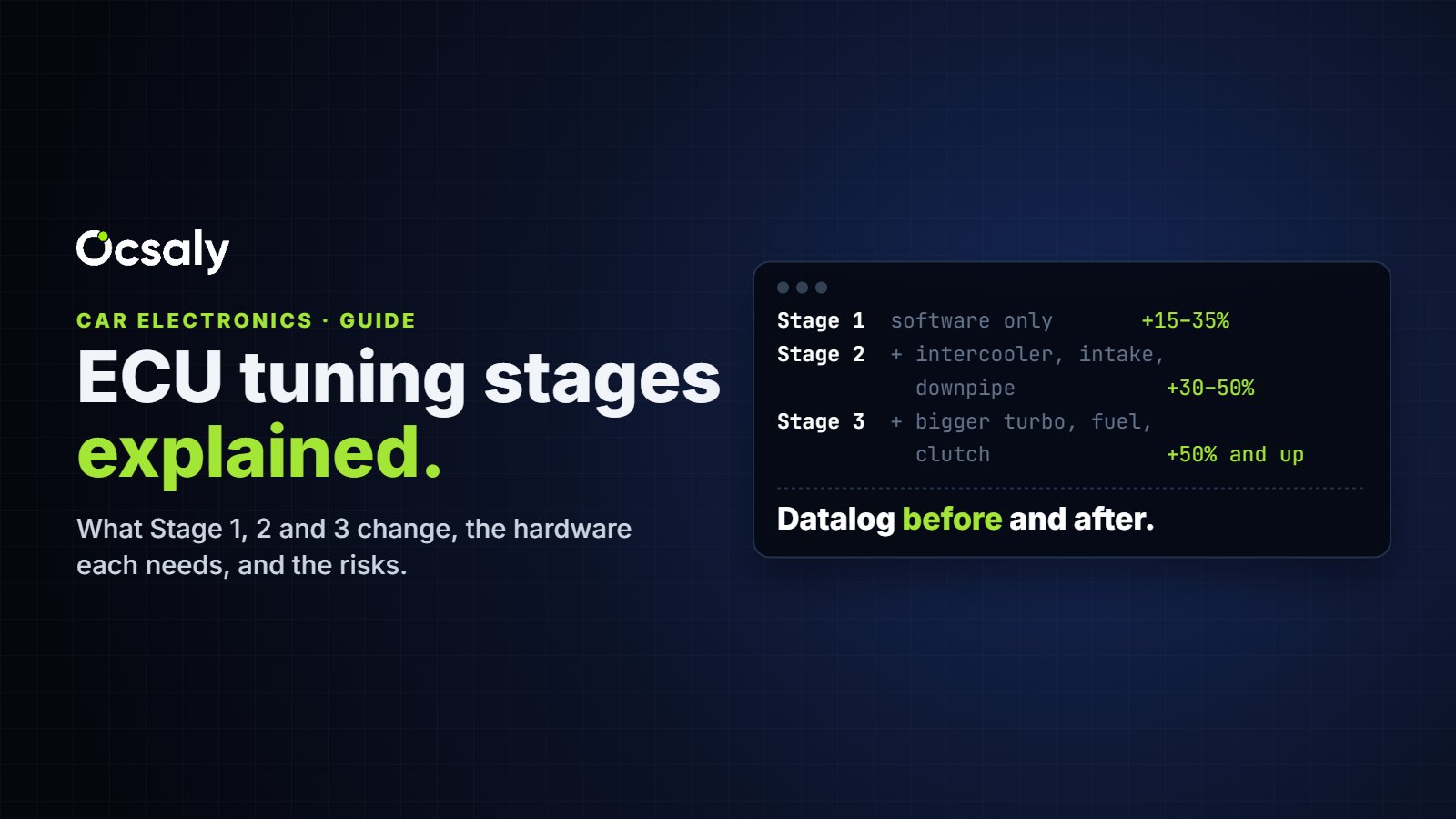
Tuning stages are a shorthand for how far a car has been modified. Stage 1 is a software remap of the engine ECU on standard hardware. Stage 2 is a remap written for supporting “breathing” parts, such as a better intercooler, intake and downpipe. Stage 3 means a bigger turbocharger or other major hardware, with fuel system and drivetrain upgrades to match. There is no official standard: every tuner defines the stages a little differently, so always ask what exactly is included.
This guide explains what each stage changes inside the ECU, typical gains, what can go wrong, and how a professional remap is done and checked.
The stages at a glance
| Stage | Hardware | Software | Typical gain, turbo petrol or diesel | Typical gain, non-turbo |
|---|---|---|---|---|
| Stage 1 | Standard | Remap of boost, fuel, ignition and torque limits | About 15 to 35% | About 5 to 10% |
| Stage 2 | Intercooler, intake, downpipe or exhaust, sometimes fuel pump | Remap written for those parts | About 30 to 50% | Small, unless camshafts or intake change |
| Stage 3 | Larger turbo, injectors, fuel pump, often clutch and cooling | Custom calibration, usually on a dyno | 50% and more | Usually forced induction or engine build |
Turbo engines gain the most from software, because the remap can ask for more boost. A naturally aspirated engine can only gain a little from ignition and fuel changes.
What a remap actually changes
An engine ECU decides how much fuel to inject, when to fire the spark and how much boost to make, by looking up values in tables called maps. A remap edits these tables:
- Torque request and limiters: the maximum torque the ECU allows in each gear and at each engine speed. Factory limits are often set well below what the engine can take.
- Boost target (turbo engines): how much pressure the turbo is asked to make.
- Fuel: the target air-fuel ratio (lambda) and, on diesels, injection quantity and timing.
- Ignition timing (petrol): how early the spark fires. More advance makes more power until the engine starts to knock.
- Protection maps: limits for exhaust temperature, smoke (diesel) and component temperatures.
How to read these tables is explained in How to Read an ECU Map.
Stage 1
A Stage 1 remap keeps the car standard on the outside. It raises boost and torque within what the original turbo, intercooler, fuel system and clutch can handle.
Good to know:
- A good Stage 1 is the best value for most daily cars.
- The clutch is often the first weak point on manual cars with large torque increases.
- Fuel quality matters: many petrol maps are written for 98 RON, and using 95 makes the ECU pull timing.
Stage 2
At Stage 2 the limiting factor becomes heat and airflow. A larger intercooler keeps intake air cooler, a less restrictive downpipe lowers exhaust back-pressure, and the map is rewritten to use that headroom.
Be careful with parts that remove emissions equipment. Removing a catalytic converter or diesel particulate filter is illegal for road cars in the EU, the UK, the US and many other countries, and the car will fail its inspection.
Stage 3 and beyond
Stage 3 usually means a larger turbo. Everything around it has to follow: injectors, fuel pump, clutch, sometimes connecting rods and gearbox. These cars are calibrated individually on a dynamometer, because no “off the shelf” file fits a unique combination of parts. Some tuners also sell “Stage 4” for fully built engines; the name means different things at different companies.
How a professional remap is done
- Health check and datalog first. Check for fault codes, misfires, boost leaks and worn coils or plugs. Tuning a sick engine makes the problem worse.
- Read the ECU and keep the original. Through the OBD-II port with a flash tool, or on the bench in boot mode when the ECU is locked. Store the original file safely: it is your way back.
- Edit the maps with an editor such as WinOLS or a tuner’s own software, or load a tested file for that exact ECU and software version.
- Write the file and correct the checksums. A wrong checksum can leave the ECU unable to start.
- Datalog and verify. Record knock activity, ignition timing, boost against target, lambda, intake air temperature and, on diesels, exhaust temperature. Adjust until all are safe, ideally on a dyno.
Risks and costs to consider
- More torque means more wear on clutch, gearbox, driveshafts and turbo.
- The manufacturer’s warranty may refuse claims on a tuned engine. Many cars record the flash counter.
- Insurers usually expect you to declare a remap.
- Fuel consumption can improve slightly at steady speed, but usually rises if you use the extra power.
Frequently asked questions
Is Stage 1 tuning safe?
A well-written Stage 1 on a healthy engine is generally safe, because it stays within the margins of the standard hardware. Problems come from aggressive files, poor fuel, worn parts and skipping the datalog check.
What is the difference between Stage 1 and Stage 2?
Stage 1 is software only on standard hardware. Stage 2 adds supporting parts such as a larger intercooler, intake and downpipe, and uses a map written for them, so it can safely run more boost and power.
Can a remap be reversed?
Yes, if the original file was saved. The original can be written back, although many ECUs keep a flash counter that shows the ECU has been programmed.
Does a remap need a dyno?
Not for a tested Stage 1 file on a standard car, where road datalogs are enough to check knock, boost and lambda. Stage 2 and especially Stage 3 calibrations should be finished on a dyno.
Will tuning affect my car’s emissions test?
A remap that keeps all emissions equipment working usually passes. Removing the catalytic converter, DPF or EGR system makes the car illegal for road use in most countries and fails the test.
Where to go next
Before anything can be remapped, you need to talk to the ECU: diagnostic sessions, security access and reading data over the CAN bus. That is what CAN Bus Hacking teaches on a bench. For live engine values, read OBD-II PIDs Explained.