On this page
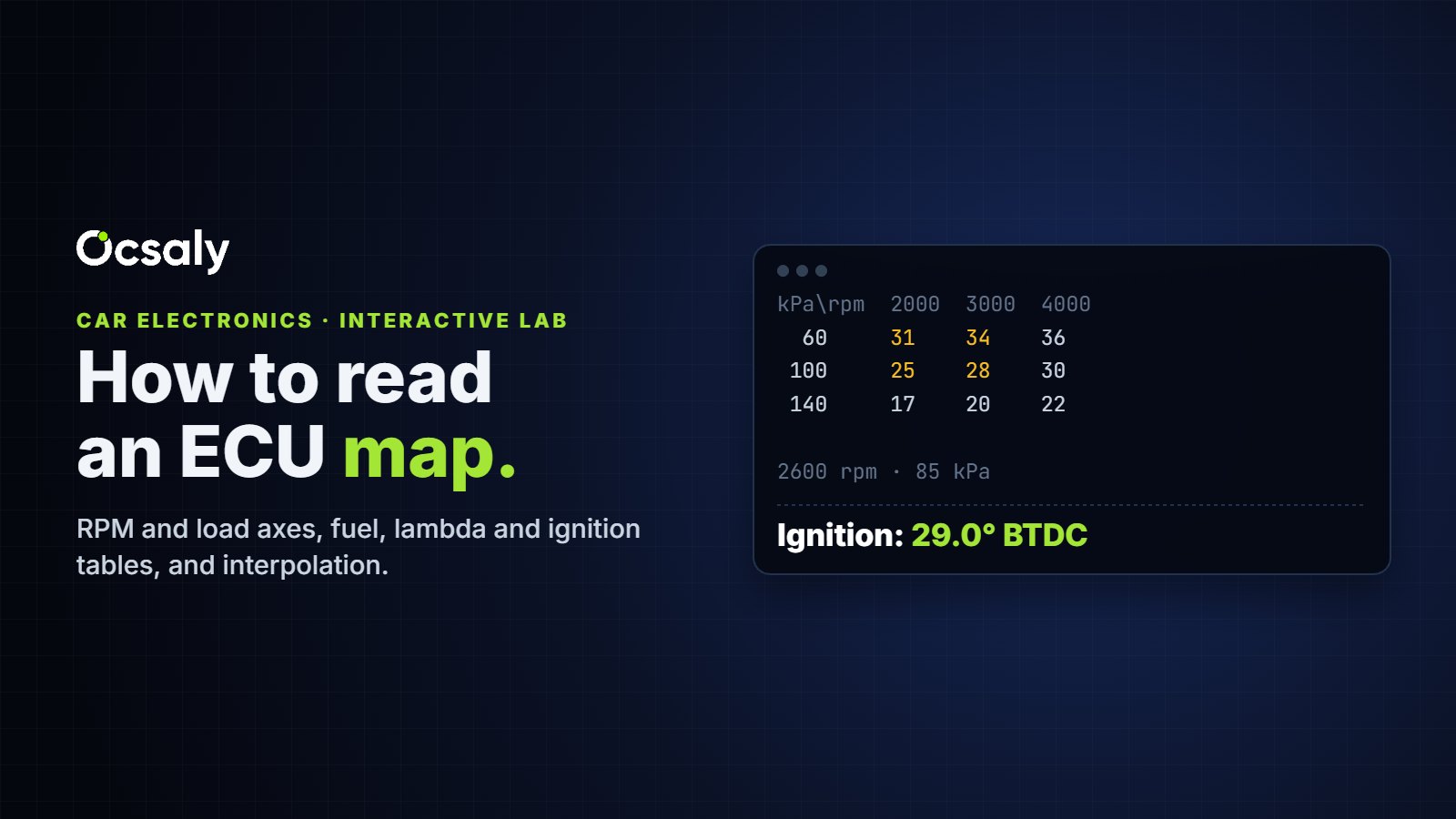
An ECU map is a table the engine computer uses to decide what to do. Most maps have engine speed (RPM) on one axis and engine load (manifold pressure, air mass or throttle) on the other, and each cell holds a value: how much fuel, how many degrees of ignition advance, what air-fuel ratio to aim for or how much boost to ask for. When the engine runs between two cells, the ECU interpolates, mixing the neighbouring values in proportion. Reading a map means finding where the engine is on the axes and understanding what the value in that area does.
This guide explains the axes, the main tables (fuel or VE, target lambda, ignition timing, boost), how interpolation works, and what to look for. Try it in the interactive ignition table at the end.
Axes: speed and load
| Axis | Usual units | What it tells the ECU |
|---|---|---|
| Engine speed | RPM | How fast the engine turns |
| Load from manifold pressure (MAP) | kPa absolute | How much air is pushed into the cylinders; above 100 kPa means boost |
| Load from air mass (MAF) | mg per stroke or g/s | How much air actually entered, measured by the air flow meter |
| Load from throttle | % | Used by some simple and older systems, and for throttle-based limits |
Low load and low RPM (top left in many editors) is idle and cruising. High load and high RPM (bottom right) is full throttle. Most driving happens in a small part of the map, which is why the cruise area is tuned for economy and the full-load area for power and safety.
The fuel table
There are two common ways to calculate fuel:
- Speed density systems use a VE (volumetric efficiency) table: the percentage of the cylinder that fills with air at each RPM and pressure. With VE, pressure and air temperature, the ECU calculates the air mass and then the fuel needed.
- Mass air flow systems measure the air directly with the MAF sensor and use the fuel tables mainly for corrections.
In both cases, the injector data (flow rate and dead time at each battery voltage) must be correct, or every fuel value will be off.
Target lambda (air-fuel ratio)
The lambda table holds the air-fuel mixture the ECU aims for.
| Lambda | AFR (petrol) | Where it is used |
|---|---|---|
| 1.00 | 14.7:1 | Idle and cruise, so the catalytic converter works |
| 0.85 to 0.90 | 12.5 to 13.2:1 | Full load on many naturally aspirated engines |
| 0.75 to 0.82 | 11 to 12:1 | Full load on many turbo engines, to keep temperatures down |
At light load the ECU runs in closed loop: it reads the lambda sensor and corrects the fuel continuously. At full load it often runs in open loop, using the table directly, so the table must be right.
Ignition timing and knock
The ignition table holds the spark advance in degrees before top dead centre (BTDC). More advance lets the mixture burn at the best moment and makes more torque, up to a point. Too much advance causes knock: the mixture explodes instead of burning smoothly, which can damage pistons quickly.
Typical patterns: high advance at light load (30 to 40 degrees at cruise is common), much less at full load and boost. A knock sensor listens for knock and the ECU pulls timing in the affected cylinder. When you read a datalog, steady knock corrections in one area mean the map, the fuel or the engine needs attention.
Boost and torque tables
Turbo engines add tables for boost target, wastegate control and torque limits. Modern ECUs are torque-based: the accelerator pedal requests torque, and the ECU works out the airflow, boost, fuel and timing needed to deliver it. That is why a modern remap often changes torque limits and conversion tables, not only fuel and spark.
How interpolation works
Each axis has only 8 to 32 break points, but the engine runs at every speed and load in between. The ECU finds the four cells around the current point and blends them by distance: 25% of the way from 2,000 to 3,000 rpm takes 75% of the 2,000 rpm value and 25% of the 3,000 rpm value, and the same on the load axis. This is called bilinear interpolation. It is why a single wrong cell affects the area around it, and why smooth maps run smoothly.
Reading a map safely
- Always keep the original file and compare against it. A map editor’s difference view shows what a tuner changed.
- Check the units of each axis and value. The same table can show raw numbers or converted values depending on the definition file.
- Look for smooth shapes. Sudden steps between neighbouring cells usually mean an error.
- Read maps together with a datalog of the real engine: knock, lambda, boost and intake temperature tell you whether the table works.
Interactive lab: read an ignition map
Frequently asked questions
What is a VE table?
A volumetric efficiency table tells the ECU how well the cylinders fill with air at each engine speed and pressure, as a percentage. Speed-density ECUs use it with pressure and air temperature to calculate the air mass and the fuel needed.
What does load mean in an ECU map?
Load is how hard the engine is working, usually measured as manifold pressure in kPa, air mass per stroke, or throttle position. It forms one axis of most maps, with engine speed on the other.
Why does the ECU interpolate between cells?
Maps only have values at a limited number of speed and load points. Interpolation blends the four nearest cells so the output changes smoothly as the engine moves between them.
What is knock and why does it matter for tuning?
Knock is uncontrolled combustion that creates sharp pressure spikes in the cylinder. It is caused by too much ignition advance, too much boost, high temperatures or poor fuel, and it can destroy pistons. Knock sensors let the ECU pull timing, but a map should not rely on them.
Can I read ECU maps without a tuning tool?
You need a copy of the ECU's memory and a definition (map pack) that says where each table is and what its units are. Free editors such as TunerPro read many older ECUs; modern ECUs usually need commercial tools to read the memory.
Where to go next
Reading an ECU's memory starts with talking to it over the CAN bus: diagnostic sessions, security access and memory reads. Those skills are taught on a bench in CAN Bus Hacking. To see what each tuning stage changes, read ECU Tuning Stages Explained.