On this page
An RTL-SDR is a cheap USB radio receiver, built around the Realtek RTL2832U chip, that turns your computer into a software defined radio. The chip was made for DVB-T television dongles, but it can also send raw radio samples to the PC. With free software you can receive FM radio, aircraft, ships, weather satellites, amateur radio, pagers, car key fobs and wireless sensors, roughly from 24 MHz to 1.7 GHz, and on newer models also shortwave.
It is the cheapest way to start with SDR: a good dongle with an antenna kit costs about the same as a meal for two.
What an RTL-SDR can and cannot do
| Feature | Typical value |
|---|---|
| Frequency range | About 24 MHz to 1.7 GHz (HF below that with direct sampling or the V4 upconverter) |
| Sample rate | Up to 2.4 MS/s reliably, about 2.4 MHz of spectrum at once |
| Resolution | 8 bits |
| Transmit | No, receive only |
| Price | Roughly 30 to 50 US dollars with antennas |
It cannot transmit, and 8 bits limit its dynamic range: a very strong station nearby can overload it. For transmitting or wider bandwidth you need something like a HackRF, explained in our HackRF vs Flipper Zero comparison.
Which dongle to buy
| Model | Tuner | Notes |
|---|---|---|
| RTL-SDR Blog V4 | R828D | Built-in HF upconverter, better filtering, bias-T, metal case. The usual recommendation |
| RTL-SDR Blog V3 | R820T2 | Direct sampling for HF, still a good receiver |
| Nooelec NESDR SMArt | R820T2 | Aluminium case, TCXO, good build |
| Generic TV dongle | Various | Cheapest, often no TCXO, drifts with temperature |
Look for a TCXO (temperature-compensated oscillator). Without it the frequency drifts and narrow signals are hard to keep tuned.
Install the driver
Windows
- Plug in the dongle and do not install the TV driver.
- Run Zadig, choose Options > List All Devices, select Bulk-In, Interface (Interface 0) and install the WinUSB driver.
- Open your SDR software and select the RTL-SDR as the source.
Linux
sudo apt install rtl-sdr
echo 'blacklist dvb_usb_rtl28xxu' | sudo tee /etc/modprobe.d/blacklist-rtl.conf
sudo modprobe -r dvb_usb_rtl28xxu
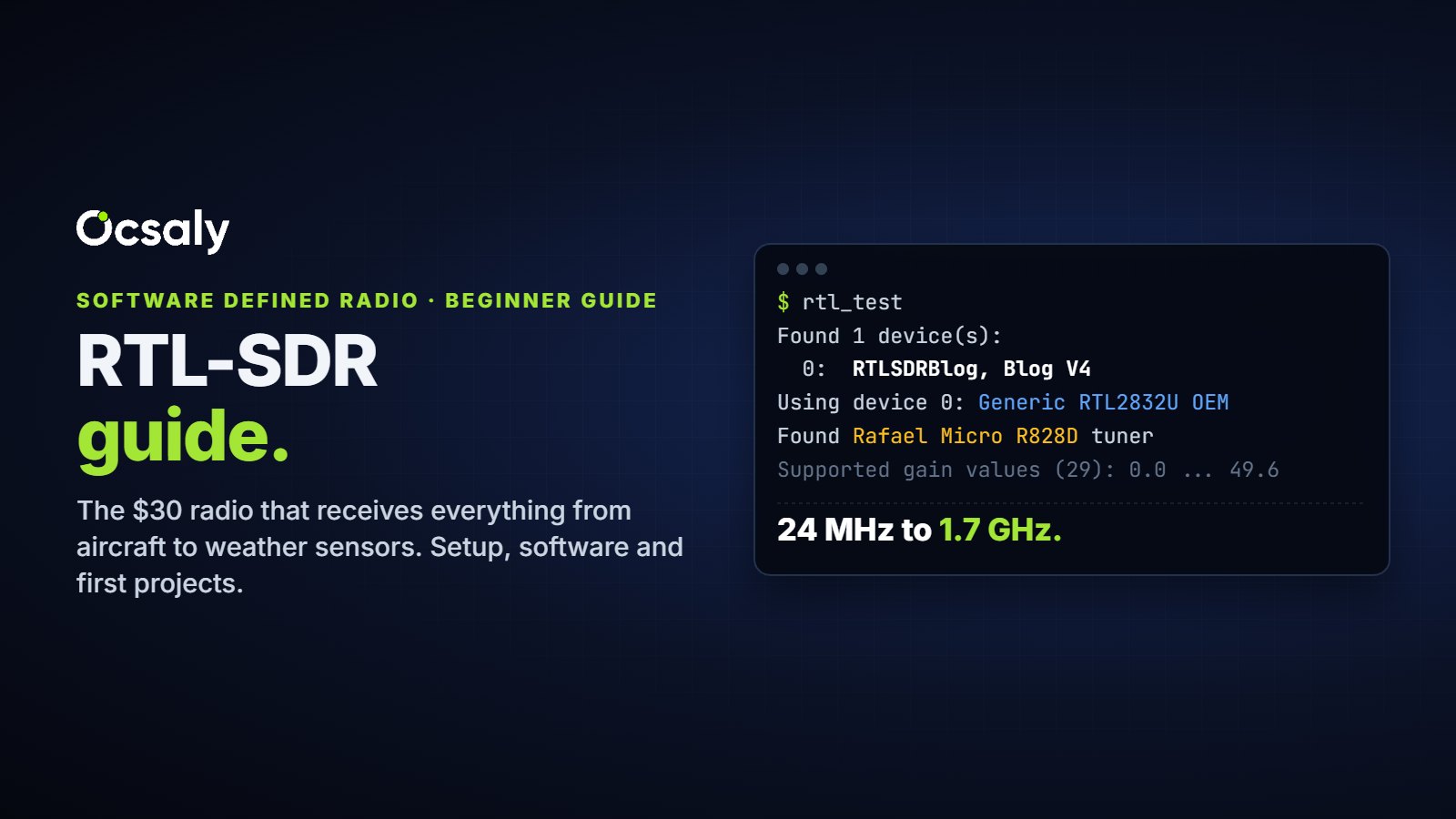
rtl_test
rtl_test should find the device and list the tuner. For the V4 on Linux, install the RTL-SDR Blog driver build, as older distribution packages may not support the R828D properly.
Best software
| Program | Platform | Good for |
|---|---|---|
| SDR++ | Windows, Linux, macOS | General listening, fast, many radios. See our SDR++ tutorial |
| SDR# (SDRSharp) | Windows | Popular, many plugins |
| GQRX | Linux, macOS | Simple receiver built on GNU Radio |
| rtl_433 | All | Decodes weather stations, tyre sensors, remotes |
| dump1090 | All | ADS-B aircraft tracking on 1090 MHz |
| GNU Radio | All | Build your own receivers and decoders |
Antennas
The telescopic dipole kit that comes with the Blog dongles is enough to start. Set each arm to about a quarter of the wavelength: for 100 MHz FM about 75 cm per side, for 1090 MHz ADS-B about 6.9 cm. Put the antenna high and near a window; a good position helps more than gain.
Eight first projects
- FM broadcast: tune 88 to 108 MHz in WFM mode. Instant proof that everything works.
- Airband: aircraft voice in AM between 118 and 137 MHz.
- ADS-B: track aircraft on a map with dump1090 on 1090 MHz.
- Weather sensors and tyre sensors: rtl_433 on 433.92 MHz (Europe) or 315 MHz (US).
- Marine AIS: ship positions on 161.975 and 162.025 MHz.
- NOAA and Meteor weather satellites: pictures from orbit around 137 MHz.
- Amateur radio: 2 m (144 to 148 MHz) and 70 cm bands.
- Key fobs: look at 433 or 315 MHz in the waterfall while pressing your own car remote. You see short bursts of data, the starting point for learning how rolling codes work.
Common problems
| Problem | Fix |
|---|---|
| Device not found | Zadig driver missing (Windows) or DVB driver loaded (Linux) |
| Same station everywhere | Gain too high, overload. Reduce the gain |
| Signals drift | No TCXO, let it warm up or use a TCXO dongle |
| Spike in the centre of the spectrum | DC offset, tune slightly off the signal |
| Samples dropped | Sample rate too high, use 2.4 MS/s or a USB 2 port without a hub |
Frequently asked questions
What does RTL-SDR stand for?
RTL comes from the Realtek RTL2832U chip used in the dongle. SDR means software defined radio: the radio work such as filtering and demodulation is done in software on your computer.
Is RTL-SDR legal?
Receiving is legal in most countries, but some forbid listening to or sharing certain transmissions such as police or mobile phone calls. Check your local rules. RTL-SDR dongles cannot transmit.
Which is better, RTL-SDR V3 or V4?
The V4 is the better buy for most people: it has a built-in HF upconverter, improved filtering and the newer R828D tuner. The V3 is still fine for VHF and UHF.
Can an RTL-SDR receive car key fobs?
Yes, it can show and record the signal of your own key fob on 315 or 433 MHz. It cannot transmit, so it cannot replay anything.
What sample rate should I use?
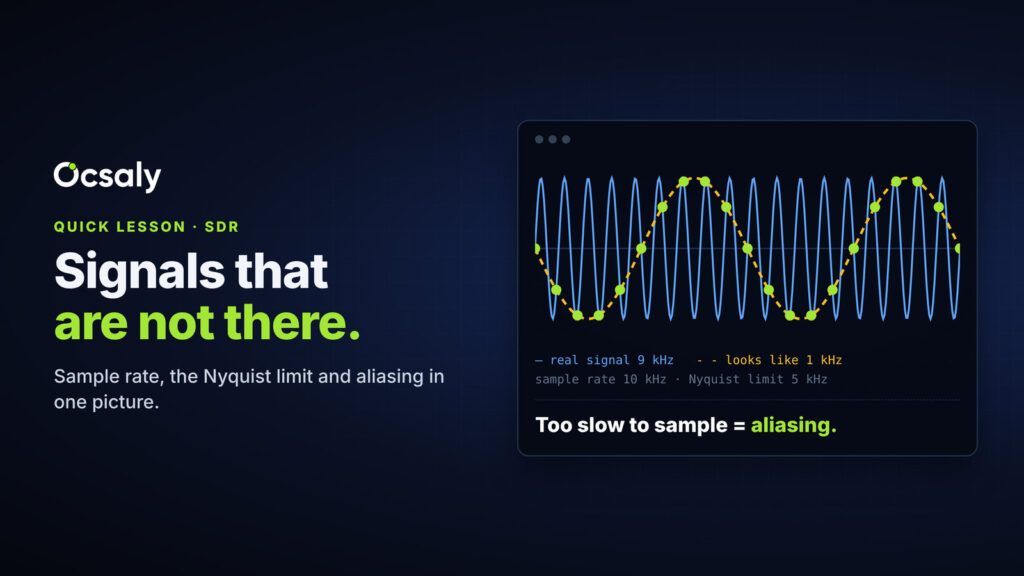
2.4 MS/s is the most reliable on almost all dongles and computers. Why the sample rate equals the visible bandwidth is explained in our guide to SDR sample rate and Nyquist.
From listening to building receivers
An RTL-SDR shows you signals. Our Software-Defined Radio and Signal Processing course teaches what happens inside: IQ samples, filters, demodulation and how to build your own receivers and decoders in GNU Radio.