On this page
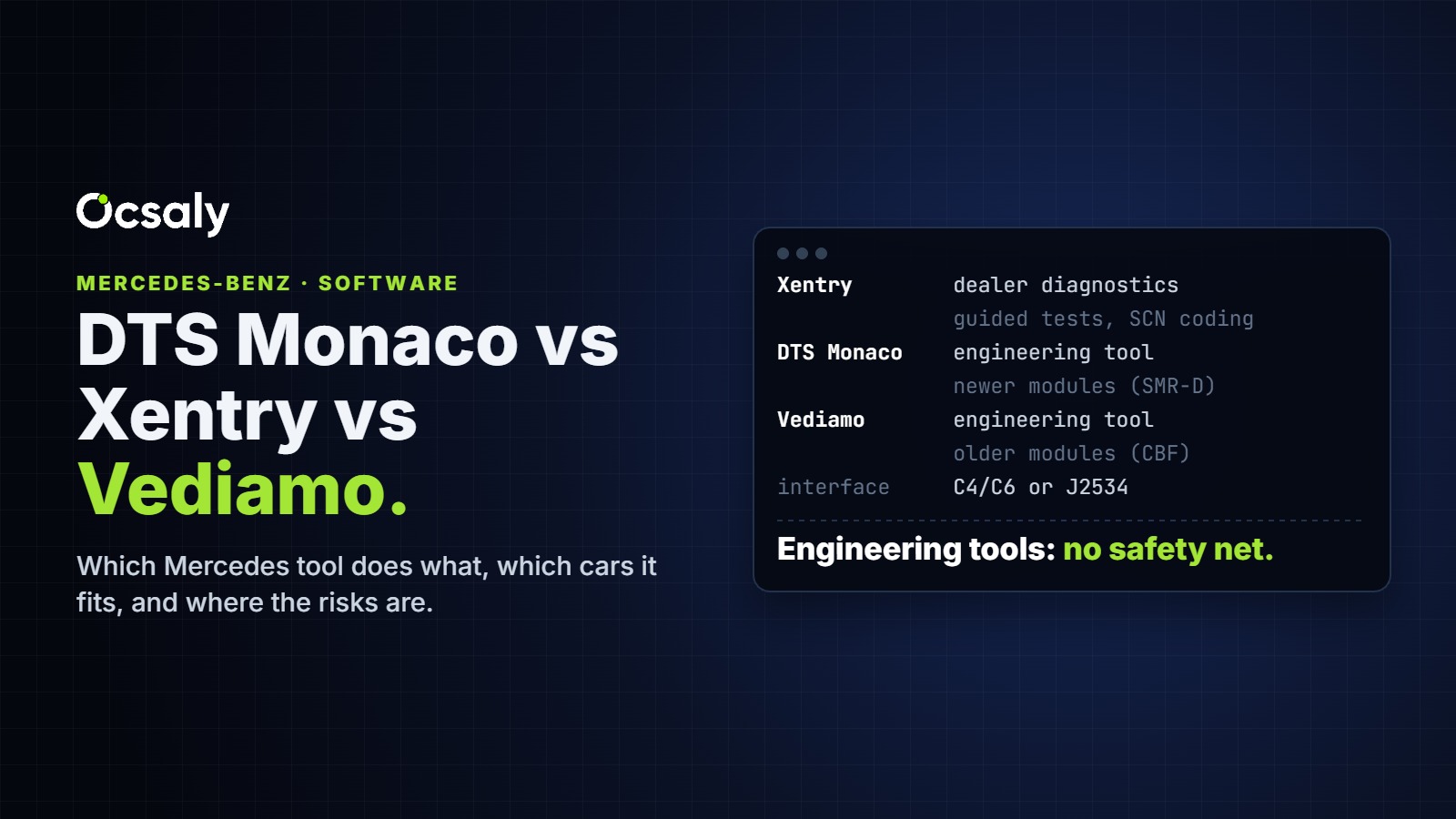
Xentry, DTS Monaco and Vediamo are the three names you hear in Mercedes-Benz diagnostics and coding. Xentry is the official workshop diagnostic software: guided fault finding, live data, tests, service functions and online (SCN) coding. DTS Monaco and Vediamo are engineering tools: they talk to individual control modules directly, let you read and change variant coding, run routines and flash software, without Xentry’s guided safety checks. Vediamo works with the description files (CBF) used by older modules, while DTS Monaco works with the newer SMR-D/ODX-based data used by most modules in current Mercedes models. All three need a diagnostic interface such as a C4 or C6 multiplexer or, for many tasks, a J2534 pass-thru device.
Xentry: the workshop tool
Xentry Diagnosis is what Mercedes dealers and many independent specialists use. It identifies the car, scans every module, explains fault codes, shows live data, runs guided tests and performs service functions: battery and sensor adaptations, brake procedures, DPF regenerations, key and component initialisation and so on. Online coding (SCN coding) and software updates need a connection to Mercedes’ servers and an account. For diagnosing a fault, Xentry is the right tool.
DTS Monaco: engineering-level access for newer models
DTS Monaco (Diagnostic Tool Set, developed by Softing) is an engineering diagnostic tool. Instead of guided menus, you open a workspace with the description data for each module and send diagnostic services directly. Typical uses:
- Reading and changing variant coding (the options a module is configured with)
- Running routines and reading identification data
- Flashing module software
It is used on most modules of newer generations, because they are described with SMR-D/ODX data that DTS Monaco reads.
Vediamo: the older engineering tool
Vediamo does a similar job for older modules that use CBF description files, common in Mercedes models from roughly the mid-2000s to the mid-2010s. Many coding guides for cars such as the W204 and W212 use Vediamo. An open-source alternative, Diogenes, also reads CBF files for some tasks. For an example of what these tools are used for on an older model, see W212 AMG Menu.
Side-by-side comparison
| Xentry | DTS Monaco | Vediamo | |
|---|---|---|---|
| Purpose | Workshop diagnostics and service | Engineering access to modules | Engineering access to modules |
| Guidance | Guided, with safety checks | None: direct services | None: direct services |
| Typical models | All current and recent | Newer modules (SMR-D/ODX) | Older modules (CBF) |
| Variant coding | Through guided and online functions | Yes | Yes |
| Flashing | Online, through Mercedes | Yes | Yes |
| Risk of mistakes | Low | High | High |
Interfaces
- C4 / C6 multiplexer: Mercedes’ own diagnostic interfaces (and widely sold clones). C6 is the newer one for current models.
- J2534 pass-thru: a standard interface that many tools support for coding and programming, used with Xentry Pass-Thru and with engineering tools for many tasks.
Whichever you use, it connects to the car through the OBD port; see the OBD2 pinout guide.
Risks of engineering tools
Engineering software trusts you completely. The most common problems:
- Low voltage during coding or flashing corrupts modules. Always use a proper power supply.
- Wrong description file or software version writes values that do not fit the module.
- No backup of the original coding means you cannot go back.
- Cloned interfaces drop connections in the middle of a write.
- Safety-relevant modules (airbag, brakes, steering) should not be changed without the manufacturer’s procedures.
Use Xentry for diagnosis and service work, and engineering tools only for well-documented changes you can undo.
Frequently asked questions
What is DTS Monaco used for?
For engineering-level work on Mercedes control modules: reading and changing variant coding, running routines and flashing software, mainly on newer modules described with SMR-D/ODX data.
Is DTS Monaco better than Xentry?
They do different jobs. Xentry is for guided diagnosis and service functions with safety checks. DTS Monaco is for direct, unguided access to modules. Workshops use Xentry every day and engineering tools only for specific tasks.
What is the difference between Vediamo and DTS Monaco?
Both are engineering tools. Vediamo works with CBF files used by older modules, and DTS Monaco with the SMR-D/ODX data used by newer ones.
Do I need a C4 or C6 for DTS Monaco?
A Mercedes multiplexer (C4 or C6) is the usual interface, and many tasks also work with a J2534 pass-thru device. Use a reliable interface for any coding or flashing.
Understand what these tools do under the hood
Every one of these tools sends standard diagnostic requests to modules over the car’s network. Our Car Electronics & Car Hacking course explains how ECUs communicate, how diagnostic sessions work and how to work on vehicle electronics safely.