On this page
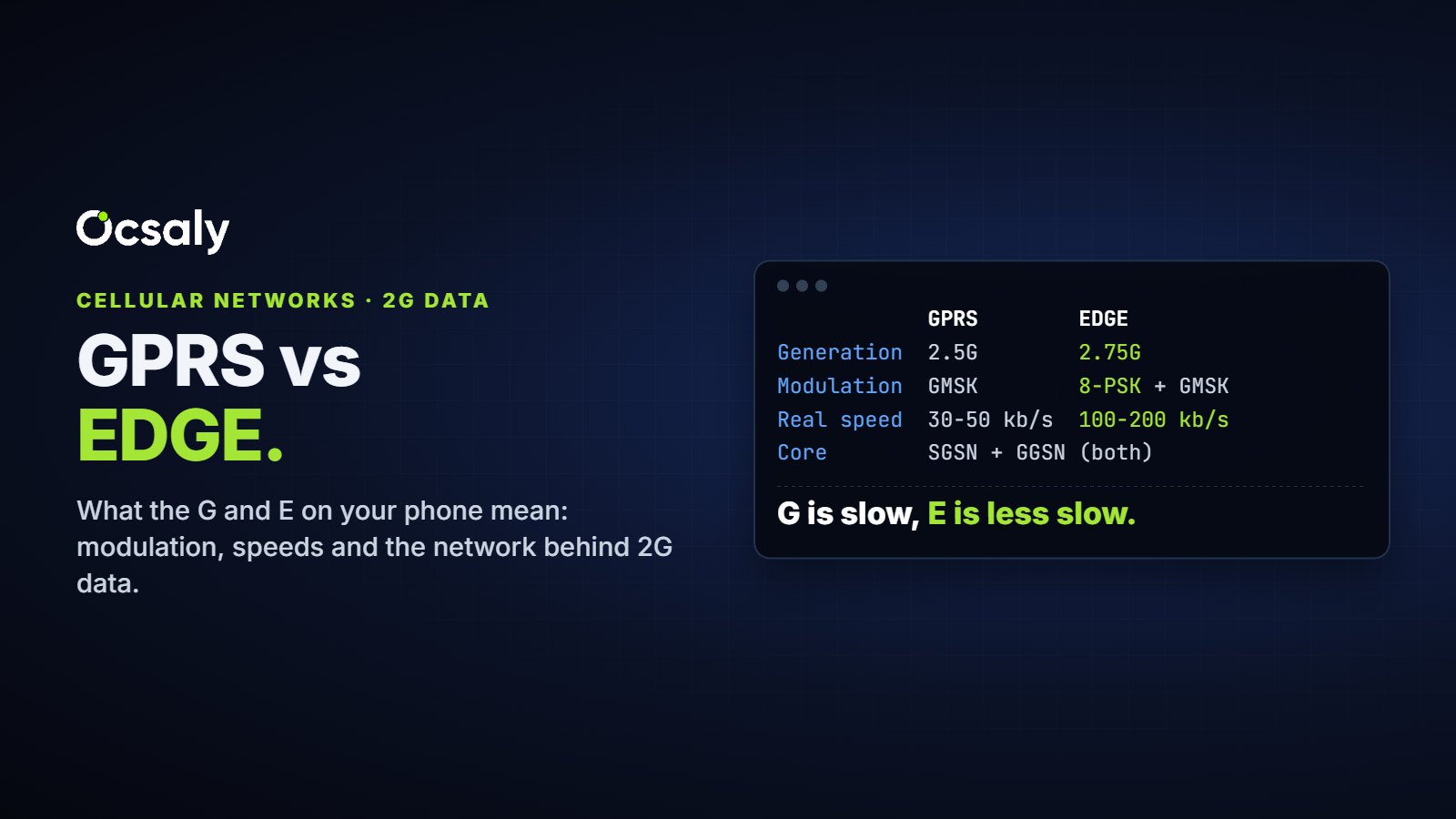
GPRS and EDGE are the packet data technologies of 2G GSM networks. GPRS (General Packet Radio Service) added always-on packet data to GSM and is often called 2.5G. EDGE (Enhanced Data rates for GSM Evolution) improved the radio part with a more efficient modulation, roughly tripling speeds, and is often called 2.75G. On a phone, G means GPRS and E means EDGE.
GPRS vs EDGE at a glance
| GPRS | EDGE | |
|---|---|---|
| Generation label | 2.5G | 2.75G |
| Modulation | GMSK | 8-PSK (plus GMSK at lower rates) |
| Coding schemes | CS-1 to CS-4 | MCS-1 to MCS-9 |
| Theoretical peak | About 85 to 170 kbit/s depending on timeslots | Up to about 470 kbit/s with 8 timeslots |
| Typical real speed | About 30 to 50 kbit/s | About 100 to 200 kbit/s |
| Phone icon | G | E |
| Core network | SGSN and GGSN | Same as GPRS |
How GPRS works
GSM was designed for circuit-switched voice: a call reserves a timeslot for its whole duration. GPRS lets data use timeslots only when there is something to send, and can combine several timeslots for one user. It added new core network elements:
| Element | Role |
|---|---|
| PCU (Packet Control Unit) | In the base station subsystem, manages packet data on the radio |
| SGSN (Serving GPRS Support Node) | Mobility, authentication and routing for data users, like an MSC for data |
| GGSN (Gateway GPRS Support Node) | Gateway to the internet, assigns IP addresses |
The SGSN works with the subscriber databases described in HLR and VLR explained.
What EDGE changed
EDGE kept the GPRS core and changed the radio: 8-PSK modulation carries 3 bits per symbol instead of 1 with GMSK, so each timeslot carries far more data in good conditions. It also adapts the coding scheme (MCS-1 to MCS-9) to radio conditions and can retransmit lost blocks more efficiently. Operators could upgrade base stations without replacing the core.
Is EDGE 2G or 3G?
EDGE runs on GSM networks and is generally treated as 2G (2.75G). It did meet some early international requirements for 3G-level data rates, which is why it is sometimes described as a 3G technology, but in everyday terms it belongs to the 2G family. 3G networks (UMTS/HSPA) use a completely different radio technology. Modern networks then moved to the all-IP LTE architecture.
Why it still matters
- Many countries have shut down 2G, but some keep it for coverage, IoT devices and older phones.
- Security research: 2G lacks mutual authentication, which is why downgrade attacks push phones to 2G. Studying GSM, GPRS and EDGE is the starting point for mobile security.
Frequently asked questions
What is the difference between GPRS and EDGE?
EDGE uses 8-PSK modulation on the same GSM network, giving roughly three times the data rate of GPRS.
What does E mean on my phone?
You are connected with EDGE, a 2G data technology, usually because 3G, 4G or 5G is not available.
How fast is EDGE?
Typically about 100 to 200 kbit/s in real use, with theoretical peaks around 470 kbit/s.
What is GPRS used for today?
Mainly fallback coverage and low-data devices such as alarms, meters and trackers, where 2G is still available.
Do GPRS and EDGE use the same core network?
Yes. Both use the SGSN and GGSN; EDGE only changes the radio interface.
Learn mobile networks end to end
Our Cellular Networks from GSM to 5G course explains every generation’s architecture and security, and our Software-Defined Radio course shows how to receive and analyse the signals.