On this page
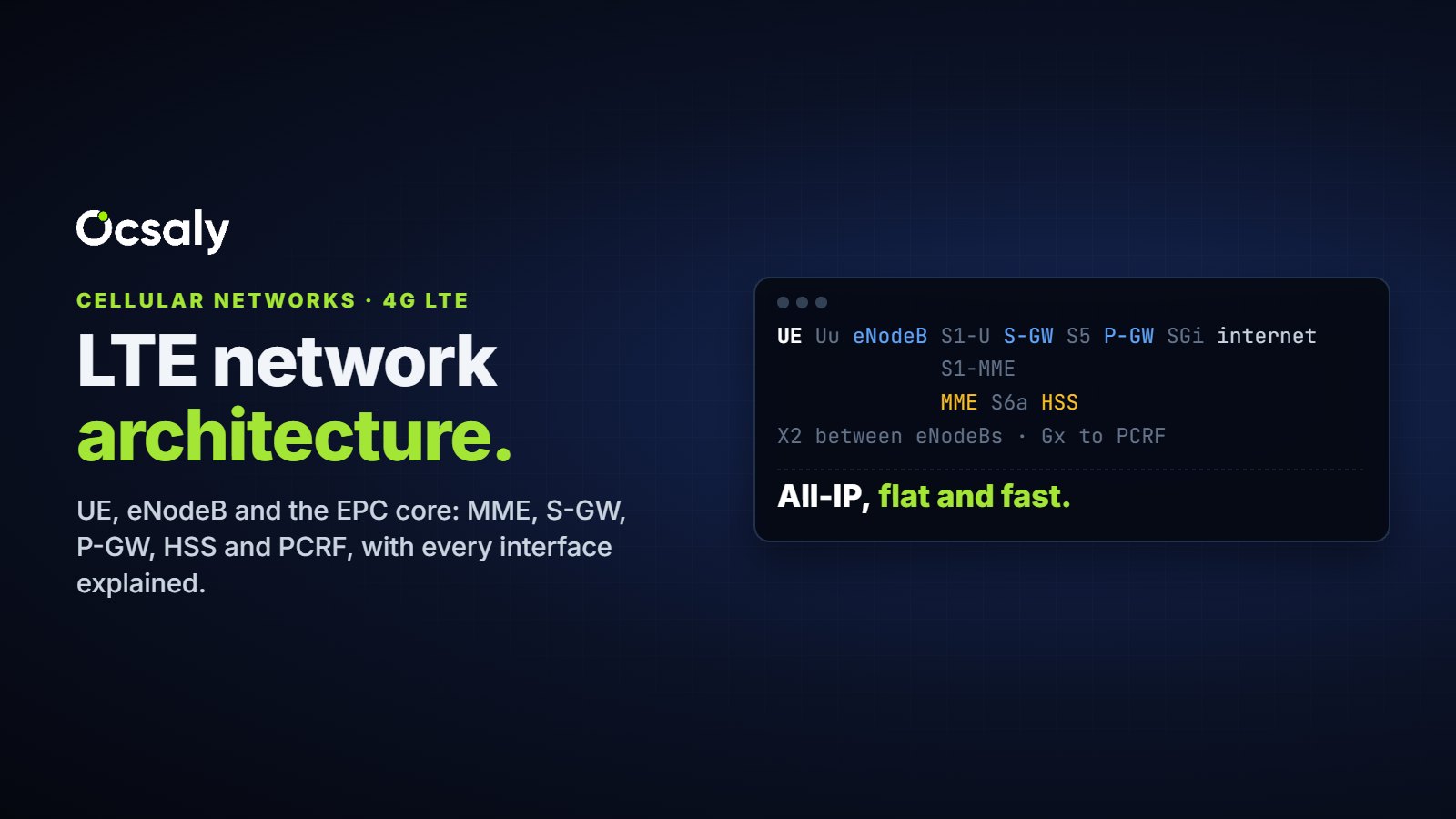
LTE (4G) was the first mobile generation built as an all-IP network. Its architecture is flatter than 2G and 3G: the base stations (eNodeB) connect directly to the core network, called the Evolved Packet Core (EPC). Voice is carried as IP too (VoLTE through the IMS). Understanding this architecture is the foundation for mobile network engineering and for cellular security research.
The main parts
| Part | Components | Role |
|---|---|---|
| User equipment (UE) | Phone, modem, SIM (USIM) | The subscriber device |
| E-UTRAN (radio access) | eNodeB | Radio, scheduling, handover with neighbours |
| EPC (core) | MME, S-GW, P-GW, HSS, PCRF | Control, user data routing, subscribers, policy |
The core network elements
| Element | What it does |
|---|---|
| MME (Mobility Management Entity) | Control plane: attach, authentication, tracking areas, paging, bearer setup, choosing gateways |
| S-GW (Serving Gateway) | User plane anchor while the UE moves between eNodeBs; forwards user data |
| P-GW (Packet Data Network Gateway) | Allocates the UE’s IP address, connects to the internet and IMS, enforces policy |
| HSS (Home Subscriber Server) | Subscriber database and authentication data, the successor of the GSM HLR |
| PCRF (Policy and Charging Rules Function) | Quality of service and charging rules |
The control plane (signalling) goes through the MME; the user plane (your actual data) goes through eNodeB, S-GW and P-GW. Separating them is a key design idea in LTE and even more so in 5G.
The interfaces
| Interface | Between | Carries |
|---|---|---|
| Uu | UE and eNodeB | The radio interface |
| X2 | eNodeB and eNodeB | Handover coordination, load information |
| S1-MME | eNodeB and MME | Control signalling (S1AP) |
| S1-U | eNodeB and S-GW | User data (GTP-U tunnels) |
| S11 | MME and S-GW | Session control |
| S5 / S8 | S-GW and P-GW (S8 when roaming) | User data and session control |
| S6a | MME and HSS | Authentication and subscriber data (Diameter) |
| Gx | P-GW and PCRF | Policy rules |
| SGi | P-GW and external networks | Internet and IMS traffic |
What happens when a phone attaches
- The UE connects over the radio to an eNodeB and sends an attach request to the MME.
- The MME gets authentication vectors from the HSS and runs mutual authentication (EPS-AKA) with the USIM.
- Security (encryption and integrity) is activated.
- The MME selects an S-GW and P-GW and sets up the default bearer; the P-GW assigns an IP address.
- The UE can now send data: UE to eNodeB to S-GW to P-GW to the internet.
LTE-Advanced and the road to 5G
LTE-Advanced added carrier aggregation, more MIMO layers and higher speeds. The first 5G deployments (non-standalone) still use the LTE EPC as their core. Standalone 5G replaces it with a service-based core: AMF, SMF, UPF, UDM and others.
| LTE (EPC) | 5G core |
|---|---|
| MME | AMF (access and mobility) + SMF (sessions) |
| S-GW / P-GW user plane | UPF |
| HSS | UDM / AUSF |
| PCRF | PCF |
Security notes
LTE introduced mutual authentication and stronger encryption than GSM, but researchers have shown weaknesses such as identity exposure before security is activated, downgrade attacks to older generations, and implementation bugs in base stations and phones. Studying them is done in labs with open-source stacks (such as srsRAN or Open5GS) and software defined radios, on licensed or shielded setups.
Frequently asked questions
What are the main components of LTE architecture?
The UE, the eNodeB in the E-UTRAN, and the EPC core with the MME, S-GW, P-GW, HSS and PCRF.
What is the difference between the MME and the S-GW?
The MME handles control signalling such as attach, authentication and mobility; the S-GW carries the user’s data traffic.
What is the EPC?
The Evolved Packet Core, the all-IP core network of LTE.
What replaced the HLR in LTE?
The HSS (Home Subscriber Server).
What is the X2 interface?
The interface between neighbouring eNodeBs, used mainly for handover and coordination.
Learn cellular networks properly
Our Cellular Networks from GSM to 5G course explains GSM, LTE and 5G architecture, signalling and security step by step.