On this page
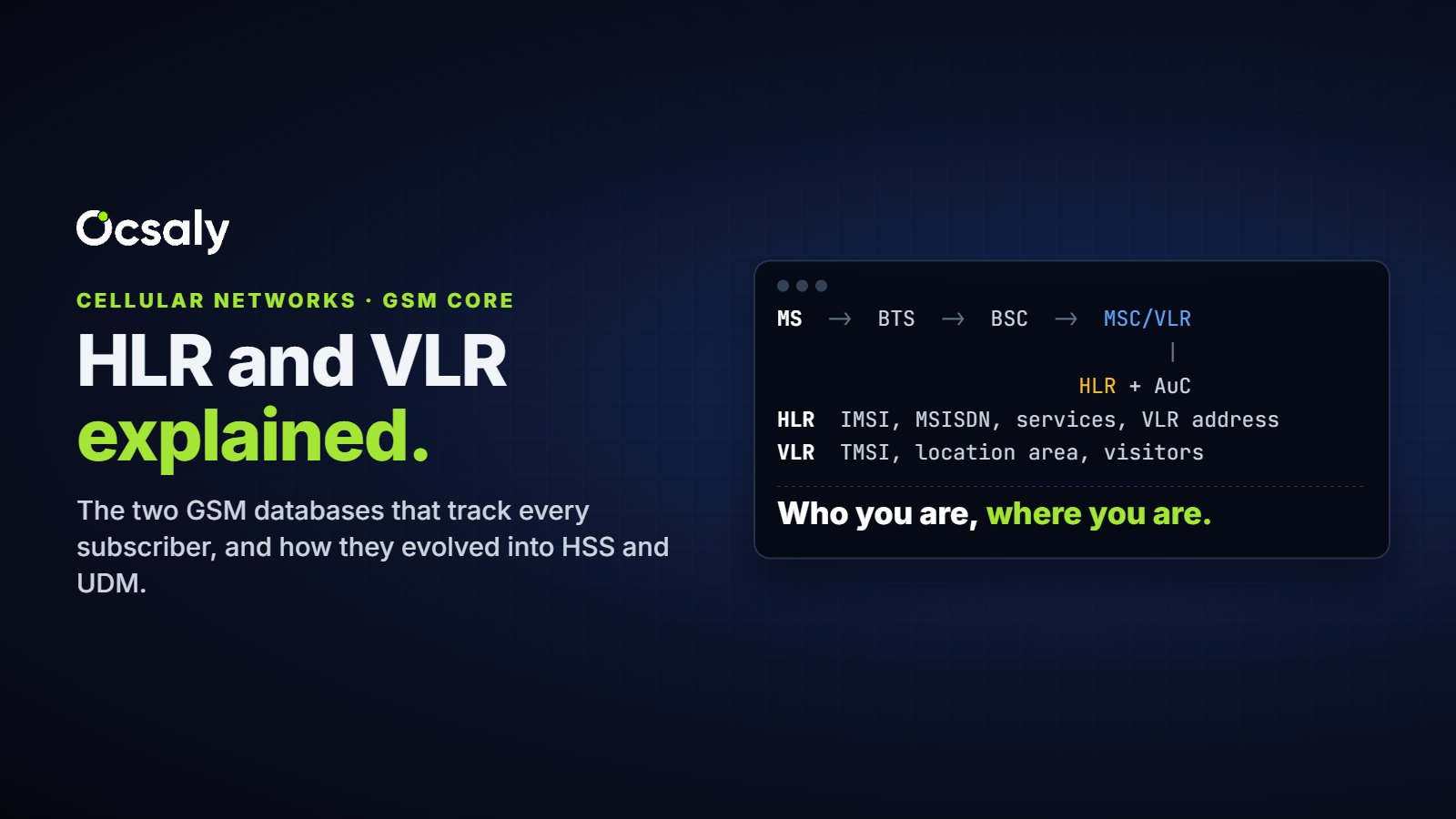
In a GSM mobile network, two databases keep track of every subscriber: the HLR (Home Location Register), which holds permanent subscriber data, and the VLR (Visitor Location Register), which holds temporary data about subscribers currently in a particular area. Together they let the network know who you are and where you are, so calls and messages can reach you.
Where they sit in the GSM architecture
| Part | Components | Role |
|---|---|---|
| Mobile station (MS) | Phone (ME) and SIM | The subscriber’s device and identity |
| Base station subsystem (BSS) | BTS (radio), BSC (controller) | Radio access |
| Network switching subsystem (NSS) | MSC, VLR, HLR, AuC, EIR | Switching, mobility, subscriber data and security |
The VLR is usually integrated with the MSC (mobile switching centre) that serves an area; the HLR is a central database of the home network.
The HLR: permanent data
| Data | Example |
|---|---|
| IMSI | The subscriber identity stored on the SIM |
| MSISDN | The phone number |
| Subscribed services | Voice, SMS, data, roaming, call forwarding |
| Current location | Address of the VLR/MSC currently serving the subscriber |
The HLR works with the AuC (Authentication Centre), which stores each subscriber’s secret key Ki and generates authentication data.
The VLR: temporary data
| Data | Example |
|---|---|
| TMSI | Temporary identity used over the air instead of the IMSI, for privacy |
| Location area | Which group of cells the phone is in |
| Copy of subscriber profile | Fetched from the HLR when the subscriber arrives |
| Authentication data | Triplets received via the HLR and AuC |
The location update, step by step
- The phone enters a new location area and sends a location update request to the serving MSC/VLR.
- The VLR authenticates the subscriber with data from the HLR/AuC (a challenge RAND, expected response SRES and cipher key Kc).
- The VLR informs the HLR of the subscriber’s new location.
- The HLR tells the old VLR to delete the subscriber and sends the subscriber profile to the new VLR.
- The new VLR assigns a new TMSI.
When someone calls you, the network asks the HLR where you are, the HLR asks the current VLR for routing information, and the call is delivered to the right MSC.
EIR: the equipment register
The EIR stores lists of device identities (IMEI): allowed, monitored and blocked (for example stolen phones).
From GSM to 4G and 5G
| GSM / 3G | 4G LTE | 5G |
|---|---|---|
| HLR + AuC | HSS | UDM + AUSF |
| VLR / MSC mobility | MME | AMF |
| SS7 / MAP signalling | Diameter | Service-based interfaces (HTTP/2) |
Security notes
HLR and VLR communicate over SS7 signalling, which was designed for trusted operators. Research and real incidents have shown that misuse of SS7 access can reveal subscriber location or intercept SMS, which is why operators now deploy signalling firewalls and why newer generations use better-protected protocols. For researchers, software defined radio and open-source network stacks make it possible to study these systems in lab environments.
Related guides: LTE network architecture, GPRS vs EDGE.
Frequently asked questions
What is the difference between HLR and VLR?
The HLR is the permanent home database for subscribers; the VLR is a temporary database for subscribers currently in an MSC’s area.
Where is the VLR located?
Usually integrated with the MSC that serves a geographic area.
What is stored in the HLR?
IMSI, phone number (MSISDN), subscribed services and the address of the subscriber’s current VLR.
What replaced the HLR in LTE?
The HSS (Home Subscriber Server), and in 5G the UDM.
What is a TMSI?
A temporary identity assigned by the VLR and used over the air to avoid sending the permanent IMSI.
Learn cellular networks end to end
Our Cellular Networks from GSM to 5G course explains GSM, LTE and 5G architecture, signalling and security, and our Software-Defined Radio course shows how to receive and analyse the radio side.