On this page
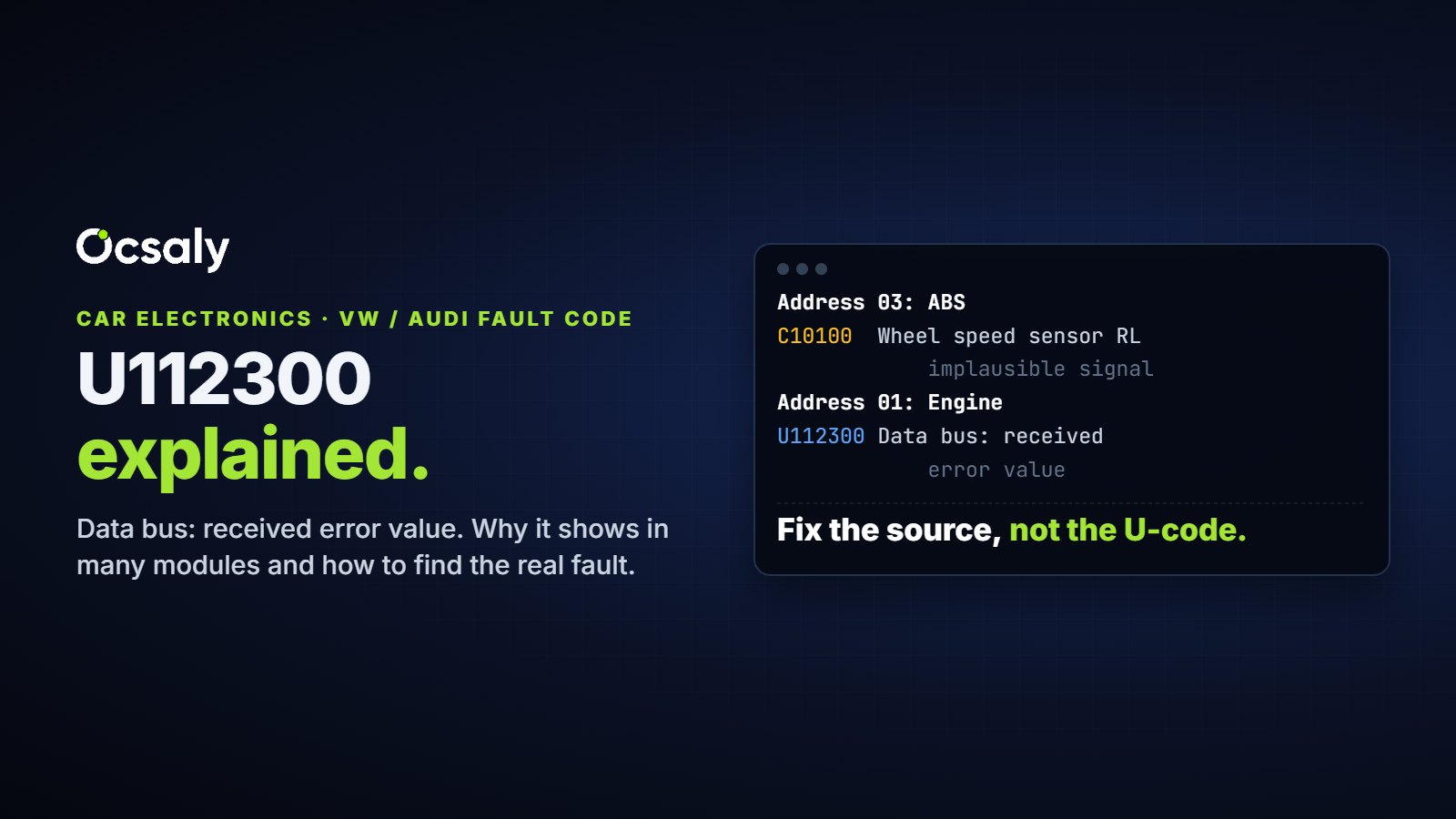
U112300 is a Volkswagen Group fault code (VW, Audi, Skoda, Seat, Cupra) that reads “Data bus: received error value” or “Databus received error message”. It means that one control module received a message over the CAN bus in which another module said: *my value is not valid right now*. The module that stores U112300 is usually not faulty itself. It is reporting that a value it needs arrived with an error flag, so the real fault is almost always in a different module.
That is why U112300 often appears in several modules at the same time, together with a “real” fault code somewhere else in the car. Fix that root fault, clear all codes, and U112300 normally disappears.
What U112300 means in plain language
Modern VW Group cars share data constantly. The ABS module sends wheel speeds, the engine sends RPM and torque, the steering angle sensor sends the wheel angle, the gateway passes messages between buses. Each message carries not only a value but also a status: valid, substitute value, or error.
When a sensor or module has a problem, it does not stop sending. It keeps sending the message but marks the value as an error. Every module that uses that value then stores a network code:
| Code | Typical description | What it tells you |
|---|---|---|
| U112300 | Data bus: received error value | A value arrived flagged as an error |
| U111300 | Function limitation due to received malfunction value | A feature is limited because of that error |
| U112100 | Data bus: missing message | An expected message did not arrive at all |
| U101400 | Control module incorrectly coded | Coding does not match the car’s equipment |
U112300 and U111300 usually appear together: one module received a bad value (U112300) and switched off or limited a function because of it (U111300).
Common causes
- A real sensor or module fault elsewhere. The most common case. For example a faulty wheel speed sensor in the ABS module, a steering angle sensor that needs calibration, or a brake light switch fault in the engine module.
- Low battery voltage. Weak batteries and long cranking cause modules to send error values for a moment. Many U112300 entries appear after a flat battery or jump start.
- Work on the car. Disconnecting the battery, replacing a module or a sensor, or an alignment without steering angle calibration all produce error values until the system is adapted.
- Coding or adaptation missing. A new module that is not coded, or a calibration that was never done, keeps sending substitute or error values.
- Wiring or connector problems. A sensor with an intermittent connection sends error values only some of the time, which is why the code can be “sporadic”.
How to diagnose U112300 step by step
- Do a full scan of all modules, not only the engine. Use VCDS, ODIS, OBDeleven or a scanner that reads every VW Group module. Save the full report before clearing anything.
- Look for the module with a non-network fault. Ignore the U-codes for a moment and find codes such as sensor implausible, open circuit, short to ground or calibration not done. That module is usually the source.
- Read the freeze frame data of the U112300 entry. Mileage, date, time and voltage tell you whether it happened once (for example during a jump start) or keeps returning.
- Check battery and charging voltage. Engine off about 12.4 to 12.7 V, engine running about 13.8 to 14.8 V. Below roughly 12 V during cranking, many modules log network faults.
- Fix the root fault, then do any required basic settings (steering angle sensor, brake pressure sensor, battery registration and so on).
- Clear all codes in all modules, drive the car, and scan again. If U112300 does not return, the job is done.
- If it returns with no other fault, check the module coding, look at the CAN wiring and connectors of the module named in the description, and check for software updates for that module.
Measured values that help
| Check | Normal | Points to |
|---|---|---|
| Battery, engine off | 12.4 to 12.7 V | Below 12.2 V: charge or test the battery |
| Battery, engine running | 13.8 to 14.8 V | Outside: charging system problem |
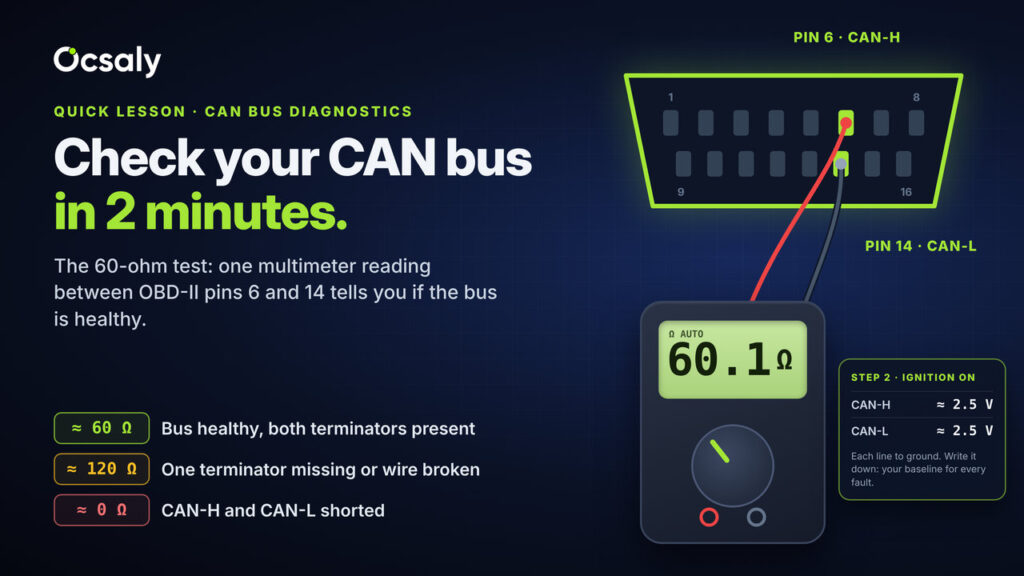
| CAN-H to CAN-L resistance (battery off) | About 60 Ω | 120 Ω: one terminator missing; near 0 Ω: short |
| CAN-H to ground (key on) | About 2.5 to 3.5 V | Fixed at 0 V or 12 V: wiring fault |
The resistance and voltage checks are done on the diagnostic CAN at the OBD-II port (pins 6 and 14). They only prove the wiring is healthy. U112300 itself is rarely a wiring fault, because the message did arrive.
Can I drive with U112300?
Usually yes, but it depends on which value is in error. If the error value comes from the ABS, steering angle or brake system, assistance systems such as ESC, lane assist or adaptive cruise control may be switched off. Warning lights on the dash are a sign that a safety function is limited. Find the root fault before relying on those systems.
Frequently asked questions
What does U112300 mean on an Audi or VW?
It means a control module received a value over the data bus that another module had marked as an error. The module storing the code is reporting the problem, not causing it. Look for the real fault in another module.
Why is U112300 stored in so many modules?
Because many modules use the same shared values. If the ABS module flags wheel speed as invalid, the engine, gearbox, steering and instrument cluster can all store U112300 at the same time.
Can a weak battery cause U112300?
Yes. Low voltage during cranking or after a flat battery is one of the most common reasons. Charge or test the battery, clear the codes and check whether they come back.
Is U112300 the same as U111300?
No, but they are related. U112300 says an error value was received. U111300 says a function is limited because of that value. They often appear together and have the same root cause.
How do I clear U112300?
Fix the root fault first, then clear codes in all modules with a scanner that reads every VW Group module. Clearing without a fix only hides it until the next drive cycle.
Learn to read the data bus yourself
Network codes such as U112300 make sense once you can see the CAN messages behind them. Our Car Electronics and Car Hacking course shows how modules talk on the CAN bus, how to capture and decode their messages, and how to find the module that is really at fault.