On this page
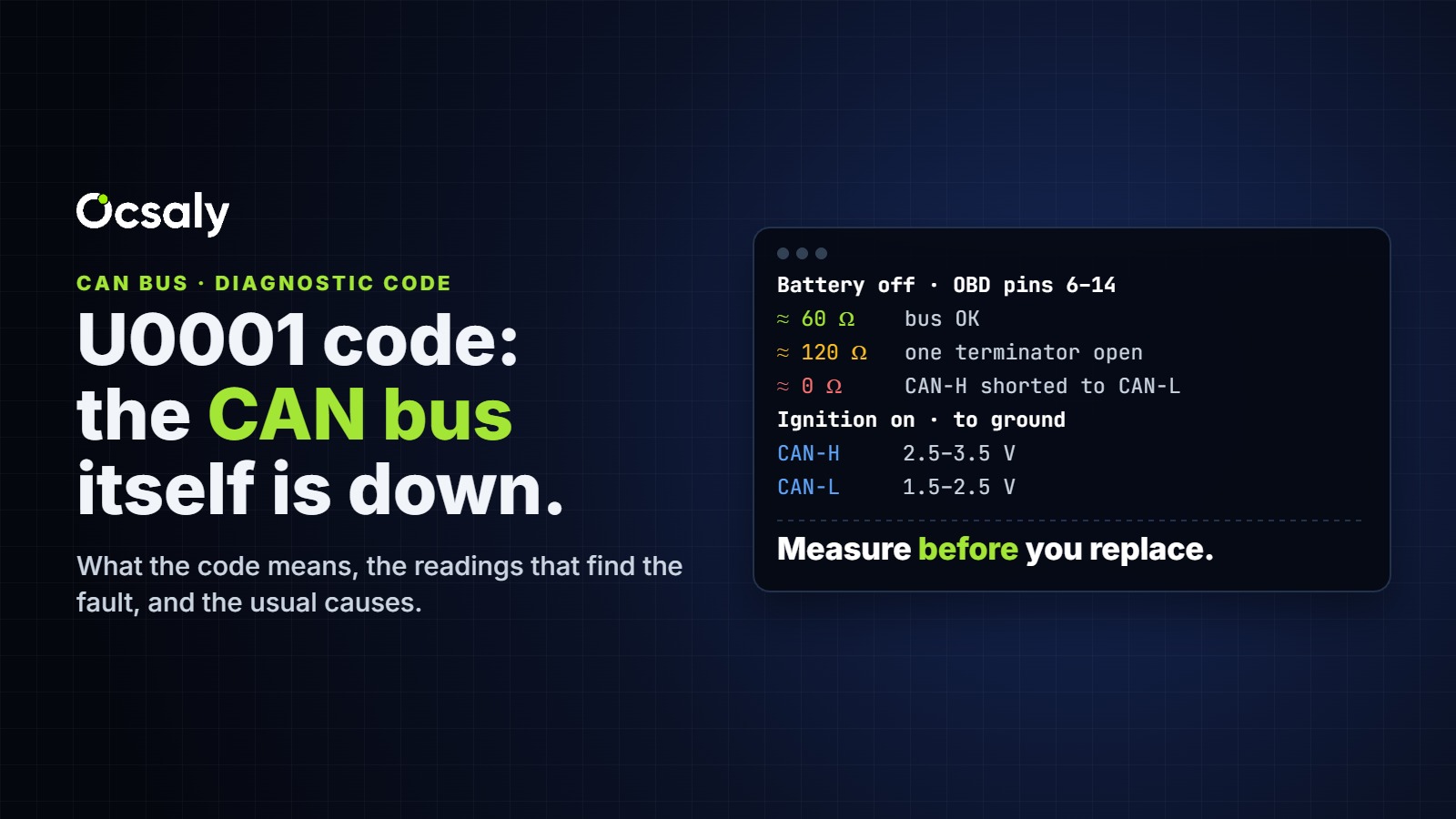
U0001 is the generic code for “High Speed CAN Communication Bus”. Unlike U0100, which says one module stopped hearing the engine computer, U0001 says a module detected a problem with the high-speed CAN bus itself: it could not send or receive messages correctly. Typical causes are a short of CAN high or CAN low to ground, to battery voltage or to each other, an open wire or missing terminating resistor, water or corrosion in a connector, or one faulty module that pulls the whole bus down. You find it with two multimeter tests at the OBD port: resistance between pins 6 and 14 with the battery disconnected, and voltage on each wire with the ignition on.
U0001 and the related bus codes
The SAE code list has a family of codes for the high-speed CAN bus. Some cars only use U0001, others narrow it down:
| Code | Meaning |
|---|---|
| U0001 | High speed CAN communication bus |
| U0002 | High speed CAN communication bus (performance) |
| U0003 | High speed CAN communication bus (+) open |
| U0004 | High speed CAN communication bus (+) low |
| U0005 | High speed CAN communication bus (+) high |
| U0006 | High speed CAN communication bus (−) open |
| U0007 | High speed CAN communication bus (−) low |
| U0008 | High speed CAN communication bus (−) high |
| U0009 | High speed CAN communication bus (−) shorted to bus (+) |
“+” is CAN high and “−” is CAN low. Manufacturers can also add their own wording, so always read the description your scan tool shows for that module.
Symptoms
- Many warning lights at once: engine, ABS, airbag, traction control
- Several modules not responding to the scan tool, or none at all
- Gauges dead or jumping
- No start, or starts and then stalls, on cars where the immobilizer and engine messages travel over CAN
- Faults that come and go with rain, car washes, bumps or temperature
How the high-speed CAN bus works (in one minute)
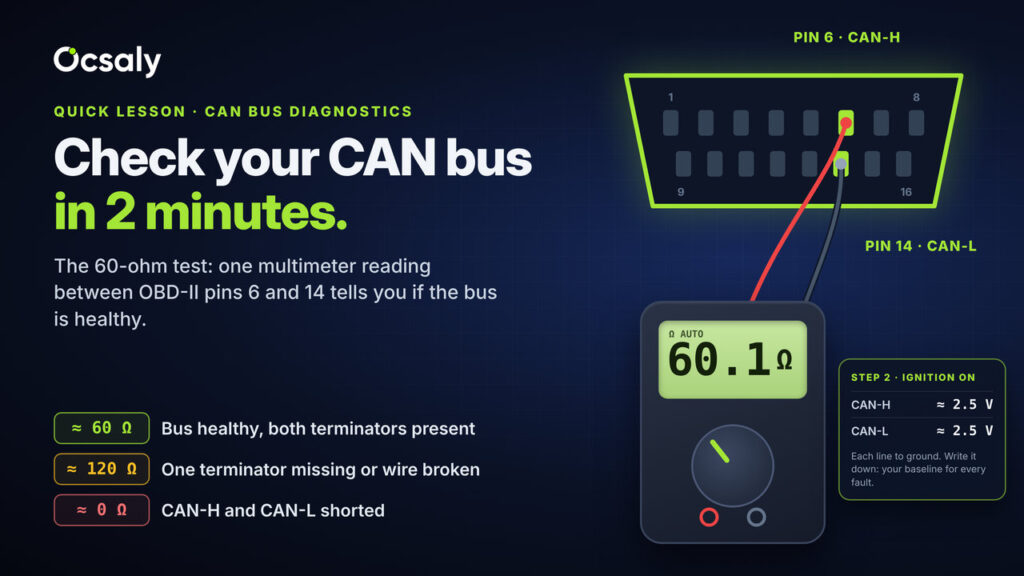
The bus is two twisted wires, CAN high and CAN low, connecting the engine, transmission, ABS and other important modules. Each end of the bus has a 120 Ω terminating resistor, usually inside a module, so the two wires measure about 60 Ω between them. When a module sends a dominant bit, CAN high rises toward about 3.5 V and CAN low drops toward about 1.5 V; at rest, both sit near 2.5 V. Every module compares the difference between the wires, which is why the bus tolerates noise but not a wire shorted to ground or to 12 V. The full explanation is in CAN Bus Explained: Voltages, Frames and the 60-Ohm Test.
How to diagnose U0001 step by step
- Scan all modules. Write down which ones store U0001 or other U codes and which do not answer. A pattern often points to one area of the car.
- Check the battery and grounds. A low battery or a bad main ground can make modules drop off the bus. Fix those first.
- Resistance test. Disconnect the battery, wait a few minutes, and measure between OBD pin 6 (CAN high) and pin 14 (CAN low). Use the table below.
- Short-to-ground and short-to-power test. Still with the battery disconnected, measure resistance from pin 6 to ground and from pin 14 to ground. It should be high (kilo-ohms or more), not close to 0 Ω.
- Voltage test. Reconnect the battery, ignition on. Measure pin 6 to ground and pin 14 to ground.
- Divide and conquer. If the bus is shorted or dead, unplug modules one at a time (or open the bus at junction connectors) and watch the readings. When the bus recovers, the last thing you unplugged is the fault or sits on the faulty branch.
- Inspect the wiring there. Look for chafing, crushed looms, corrosion and water, especially at door and boot hinges, under carpets, near the battery and at aftermarket installations.
What the readings mean
| Reading | Likely cause |
|---|---|
| About 60 Ω between 6 and 14 | Both terminators and the main wires are fine |
| About 120 Ω | One terminator or one wire to it is open |
| Several kΩ or open | Both terminators missing or the OBD port is not connected to this bus |
| Near 0 Ω | CAN high shorted to CAN low |
| CAN high or low near 0 V with ignition on | That wire is shorted to ground |
| CAN high or low near 12 V | That wire is shorted to battery voltage |
| Both wires at about 2.5 V, no change, nothing communicates | A module may be holding the bus or the bus is not being woken up |
A multimeter shows average voltages. To see the actual frames, error frames or a distorted signal, use an oscilloscope on CAN high and CAN low together.
Common causes of U0001
- Water in a connector or module (sunroof drains, windscreen seals, footwells)
- Chafed CAN wires touching the body (short to ground)
- Aftermarket alarms, trackers, dashcams or remote starters spliced into the bus
- A failed module that shorts the bus internally
- A missing or damaged terminating resistor after a module was replaced or removed
- Poor repairs: wires joined without twisting, or with the wrong cable
Frequently asked questions
What is the difference between U0001 and U0100?
U0001 means the high-speed CAN bus itself has a problem, so many modules may be affected. U0100 means one module lost communication with the engine computer, which can be a single wire, power or ground fault at the ECM.
Can I drive with a U0001 code?
Sometimes, but it is risky. If the bus fails while driving, the engine, transmission, ABS and stability control can lose communication. Diagnose it before relying on the car.
Can a bad module cause U0001?
Yes. A module with an internal short can pull CAN high or CAN low to ground or to each other and take down the whole bus. Unplugging modules one at a time shows which one.
What resistance should a CAN bus have?
About 60 Ω between CAN high and CAN low, measured with the battery disconnected. That is two 120 Ω terminating resistors in parallel.
Go deeper into vehicle networks
Diagnosing network faults confidently means understanding how the bus works at the signal level. Our Car Electronics & Car Hacking course covers CAN wiring, termination, capturing and decoding frames and building your own CAN interface.