On this page
In digital forensics, live forensics (live acquisition) means collecting evidence from a system while it is running. Dead forensics (post-mortem or static acquisition) means collecting evidence from a system that has been powered off, usually by imaging its disks. Each approach captures different evidence and carries different risks, and modern investigations often use both.
Live vs dead at a glance
| Live forensics | Dead (post-mortem) forensics | |
|---|---|---|
| System state | Running | Powered off |
| Captures | RAM, running processes, network connections, logged-in users, decrypted volumes | Complete disk contents, deleted files, file system metadata |
| Main risk | Your actions change the system; malware may react | Volatile evidence is lost when power is removed |
| Typical tools | Memory acquisition tools, triage scripts | Write blockers, imaging tools (dc3dd, Guymager, FTK Imager) |
| Repeatability | Cannot be repeated exactly | Image can be verified and re-examined |
The order of volatility
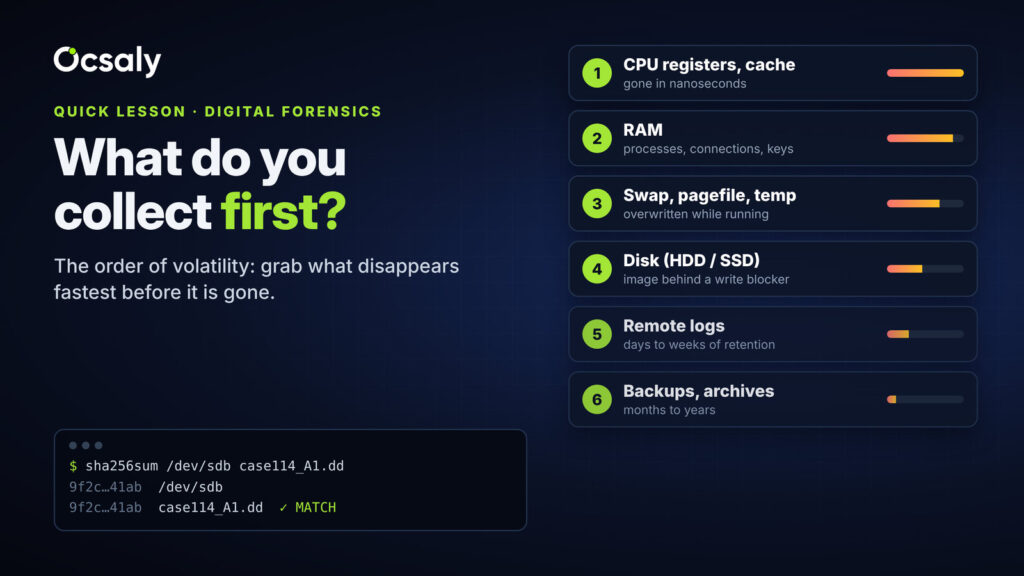
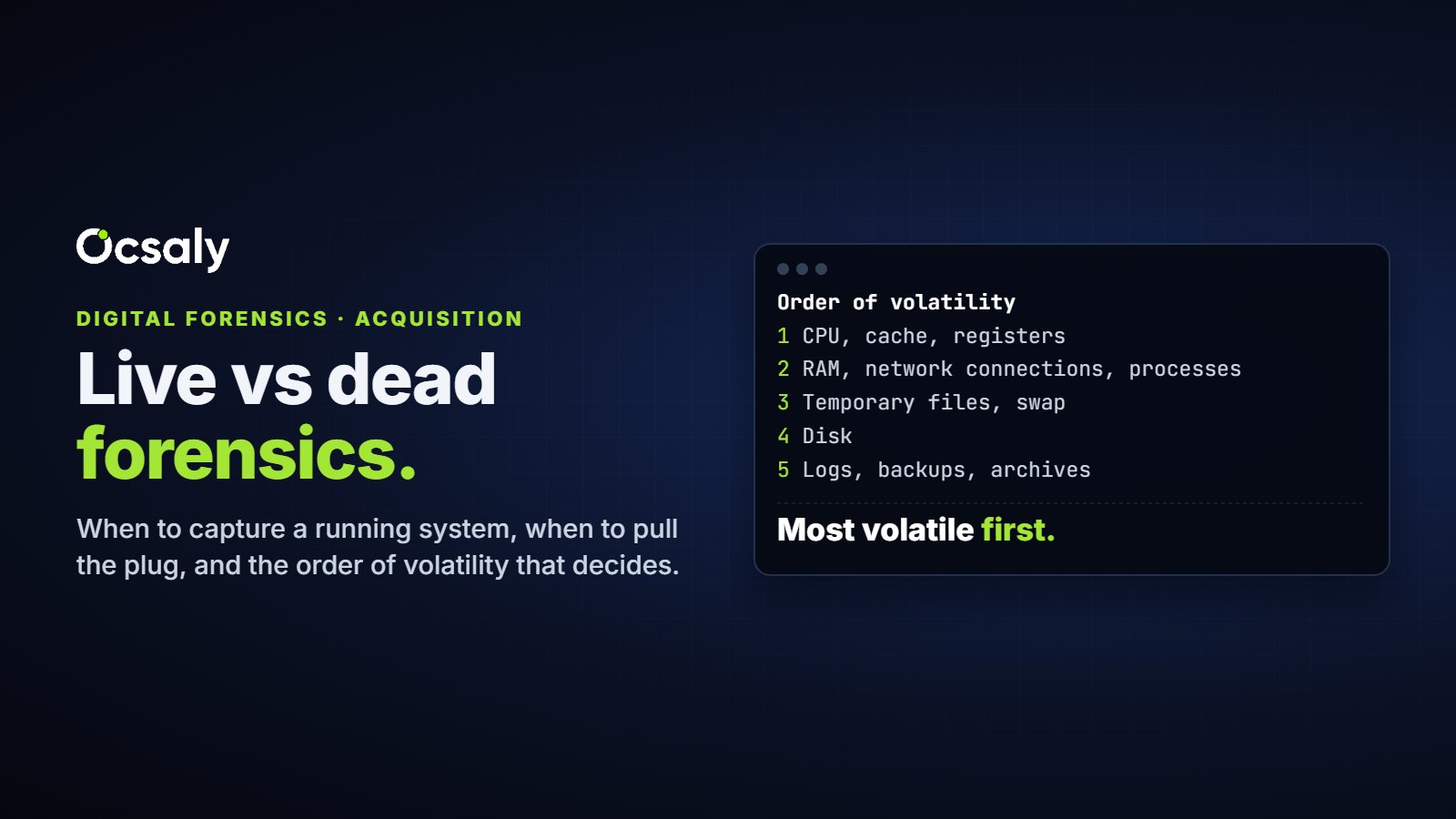
Evidence should be collected from the most volatile (disappears first) to the least volatile, as described in RFC 3227:
| Order | Evidence | Lost when |
|---|---|---|
| 1 | CPU registers and cache | Instantly |
| 2 | Memory (RAM): processes, network connections, keys, malware in memory | Power off |
| 3 | Temporary file systems and swap | Reboot or cleanup |
| 4 | Disk | Overwritten over time |
| 5 | Remote logs and monitoring data | Log rotation |
| 6 | Archives and backups | Rarely |
When live acquisition is the right choice
- Full-disk encryption is unlocked now; powering off would lock the data behind a key you do not have.
- You suspect fileless or memory-resident malware.
- You need network connections, running processes or logged-in sessions.
- The system is critical and cannot be shut down (servers, industrial systems).
When dead acquisition is the right choice
- The system is already off.
- Disk evidence is what matters (documents, deleted files, timelines).
- You need the most defensible, repeatable process: an image with verified hashes.
A typical combined workflow
- Document the scene: photos, screen contents, running state.
- Capture RAM with a trusted memory acquisition tool from external media, and hash the output.
- Collect volatile information: processes (for example ps aux on Linux), network connections, logged-in users.
- Decide how to shut down (graceful shutdown or pulling power) based on the risks.
- Image the disks through a write blocker with a tool such as dc3dd, and verify the hashes.
- Record everything in the chain of custody.
Image format choices are explained in forensic image formats: E01, raw and AFF4.
Minimising your footprint during live acquisition
- Run tools from external, trusted media; do not install software on the suspect system.
- Write output to external storage, not the suspect disk.
- Use as few commands as possible and log each one with time stamps.
- Hash every file you collect.
Frequently asked questions
What is live forensics?
Collecting evidence from a running system, especially volatile data such as RAM, processes and network connections.
What is dead or post-mortem forensics?
Examining a powered-off system, usually by creating and analysing forensic images of its storage.
Why is RAM evidence important?
It can contain running malware, encryption keys, passwords, network connections and activity that never reaches the disk.
Does live acquisition change evidence?
Yes, every action on a running system changes something. That is why investigators minimise and document every step.
What is the order of volatility?
The order in which evidence disappears, from CPU and RAM (fastest) to disk and backups (slowest). Collect the most volatile first.
Learn forensic acquisition hands-on
Our Digital Forensics course covers live and dead acquisition, memory forensics, disk imaging and chain of custody with practical labs.