On this page
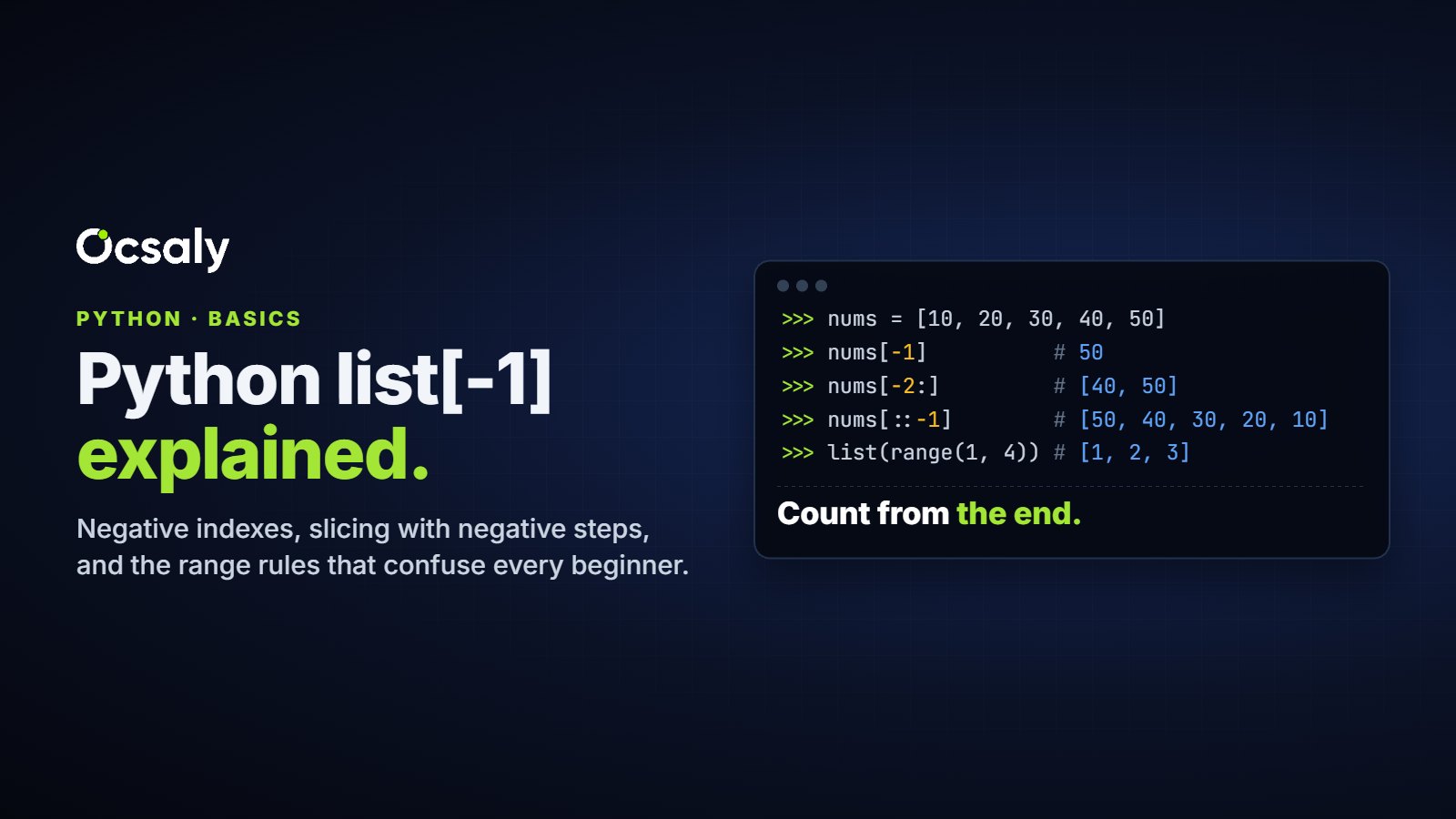
In Python, list[-1] returns the last element of a list. Negative indexes count from the end: -1 is the last item, -2 the second to last, and so on. The same rule works for strings, tuples and other sequences.
nums = [10, 20, 30, 40, 50]
nums[0]     # 10  first
nums[-1]    # 50  last
nums[-2]    # 40  second to last
How negative indexes map
| Positive index | 0 | 1 | 2 | 3 | 4 |
|---|---|---|---|---|---|
| Value | 10 | 20 | 30 | 40 | 50 |
| Negative index | -5 | -4 | -3 | -2 | -1 |
Python simply adds the length: nums[-1] is nums[len(nums) - 1]. An index beyond the start, such as nums[-6] here, raises IndexError, and so does [][-1] on an empty list.
Slicing with negative numbers
Slices use [start:stop:step], where stop is not included:
nums[-2:]      # [40, 50]          last two
nums[:-1]      # [10, 20, 30, 40]  everything except the last
nums[-3:-1]    # [30, 40]
nums[::-1]     # [50, 40, 30, 20, 10]  reversed copy
nums[::2]      # [10, 30, 50]      every second item
Slices never raise IndexError; out-of-range slices just return fewer items or an empty list.
range() and the “exclusive end” rule
range(start, stop) works like slicing: start is included, stop is not.
list(range(5))         # [0, 1, 2, 3, 4]
list(range(1, 4))      # [1, 2, 3]
list(range(10, 0, -2)) # [10, 8, 6, 4, 2]
for i in range(len(nums)):
    print(i, nums[i])
To include the end value, use range(1, n + 1). Usually it is cleaner to loop directly or with enumerate:
for i, value in enumerate(nums):
    print(i, value)
Common mistakes
| Mistake | Fix |
|---|---|
Expecting range(1, 10) to include 10 | Use range(1, 11) |
Off-by-one with nums[len(nums)] | The last index is len(nums) - 1, or just nums[-1] |
nums[-1] on an empty list | Check if nums: first |
| Modifying a list while looping over it | Loop over a copy: for x in nums[:] |
Frequently asked questions
What does [-1] mean in Python?
The last element of a sequence such as a list, string or tuple.
How do I get the last 3 items of a list?
Use the slice nums[-3:].
How do I reverse a list in Python?
nums[::-1] returns a reversed copy; nums.reverse() reverses the list in place.
Is range() inclusive or exclusive in Python?
The start is inclusive and the stop is exclusive: range(1, 4) gives 1, 2, 3.
Does negative indexing work on strings?
Yes. “hello”[-1] returns “o”.
Learn Python for security and automation
Python is the language of most security tooling and automation. Explore our courses to go from Python basics to writing your own tools.