On this page
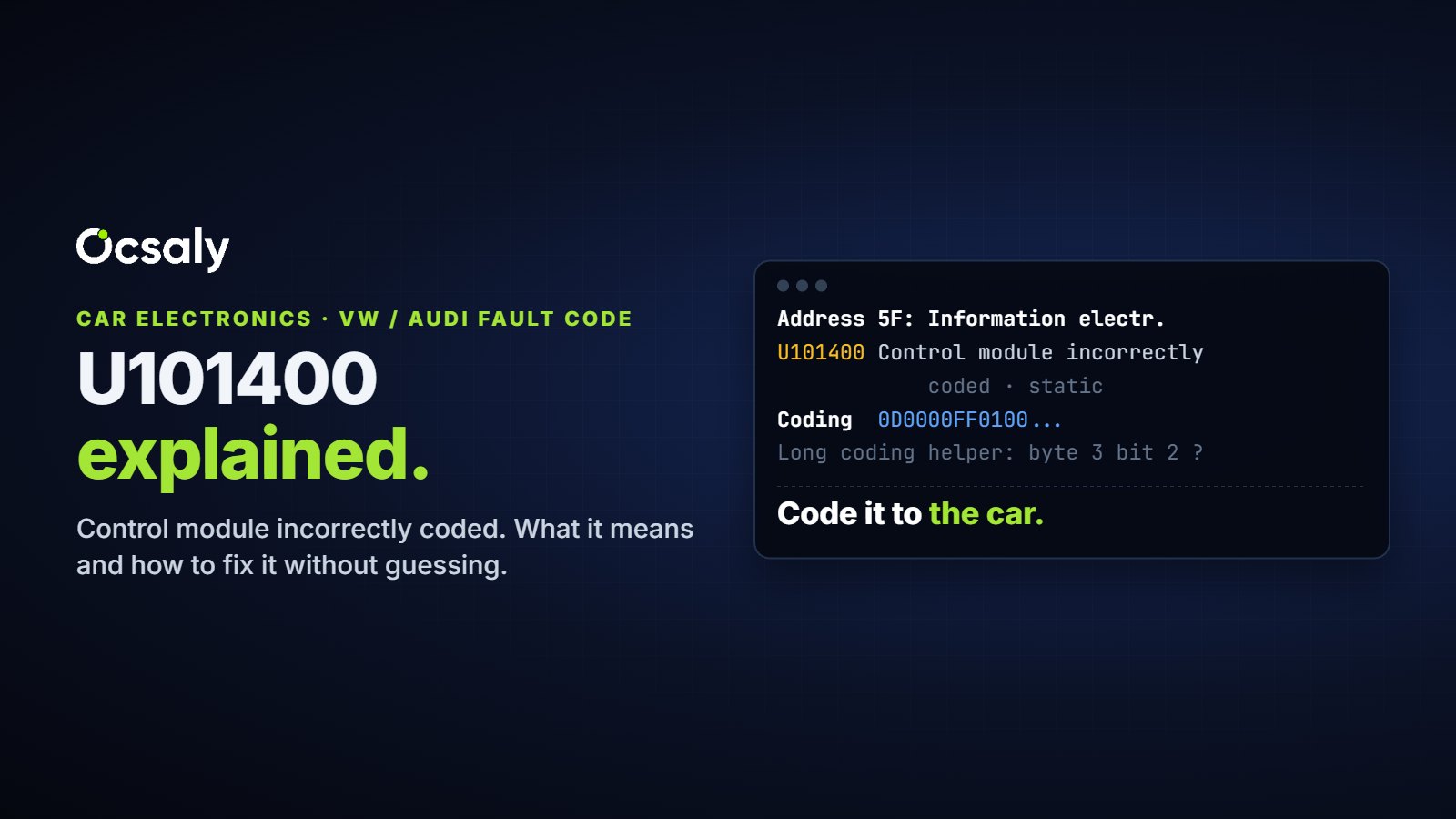
U101400 is a Volkswagen Group fault code (VW, Audi, Skoda, Seat, Cupra) that means “Control module incorrectly coded”. The module that stores it has checked its own coding against the equipment it can see on the CAN bus, and the two do not match. The car usually still drives, but features can be missing, warning lights can appear and other modules may log follow-up codes.
It is one of the most common codes after a repair, a module replacement, a battery disconnection on some models, or a retrofit such as a new radio, camera, tow bar or headlights.
What “incorrectly coded” means
Every VW Group module has a coding: a string of bytes and bits that tells it which equipment the car has. For example: left- or right-hand drive, which engine, whether there is a sunroof, which headlights, which country. The module uses the coding to decide which messages to expect on the bus and which functions to switch on.
When the module starts, it compares its coding with the messages it actually receives from other modules. If it is coded for equipment that is not there, or equipment is present that it is not coded for, it sets U101400.
| Status shown | Meaning |
|---|---|
| Static (permanent) | The mismatch is present now. Clearing will not help until the coding is fixed |
| Intermittent (sporadic) | The mismatch was seen once, often during a repair or low voltage. Clear and recheck |
Common causes
- A module was replaced with a used or new part that still has the coding of another car (or no coding at all)
- A retrofit (new radio, camera, tow bar, LED headlights, sensors) was installed but the gateway or the module was not coded for it
- Gateway installation list (address 19) not updated, so the gateway does not know the new module exists
- Coding changed with a tool (VCDS, OBDeleven, ODIS) and a bit was set wrong
- Software update that expects a different coding format
- Low voltage during coding or an interrupted write, leaving a module half coded
How to find and fix it
- Run a full scan of all modules and save it. Note which address stores U101400. It is often address 19 (gateway), 5F (infotainment), 09 (central electrics) or a newly fitted module.
- Ask what changed recently. A module swap or retrofit just before the code appeared is almost always the cause.
- Check the gateway installation list. Every fitted module must be listed as installed, and removed modules must be unticked. A wrong list causes U-codes in many modules.
- Compare the coding of the affected module with a known-good value for the same car: the original coding from a previous scan, the car’s build data, or the coding from an identical model.
- Use online or SVM coding where possible. With ODIS, the module can download the correct coding for the car from the factory data (SVM). This is the safest fix for replaced modules.
- Change one value at a time, clear the codes, cycle the ignition and scan again.
Always connect a battery charger before coding. A voltage drop during a write is a common reason for a module that stays incorrectly coded.
Typical modules and what to check
| Address | Module | Check first |
|---|---|---|
| 19 | Gateway | Installation list, coding after module replacement |
| 5F | Infotainment / radio | Coding after radio swap or retrofit, region coding |
| 09 | Central electrics (BCM) | Lights, tow bar, trailer coding after retrofits |
| 6C | Rear view camera | Camera present but not coded in 5F, or the reverse |
| A5 | Front camera / driver assist | Calibration and coding after windscreen replacement |
| 44 | Steering assist | Basic settings and coding after replacement |
Why it matters for the CAN bus
Coding decides which CAN messages a module expects and which it ignores. A module coded for a tow bar module expects that module’s messages. When they never arrive, you get U101400 in one place and often “missing message” codes such as U112100 in others. That is why one wrong coding can fill a scan with network codes. Read the first fault, fix the coding, and many of the others clear by themselves. For more on how VW modules report network problems, see U112300 data bus received error value and U111300 function limitation.
Frequently asked questions
Is U101400 serious?
Usually not dangerous, but it should be fixed. Depending on the module, it can disable functions such as the camera, driver assist, lights or the radio, and it can hide other faults in the scan.
Can I just clear U101400?
If it is intermittent, yes, clear it and recheck. If it is static, it returns immediately because the coding still does not match. The coding must be corrected.
Can OBDeleven or VCDS fix U101400?
Often yes, when you know the correct coding value. Both tools let you read and change long coding. For replaced modules on newer cars, online coding with ODIS (SVM) is sometimes the only clean fix.
Why did U101400 appear after a battery change?
A deep discharge or disconnect can make some modules lose adaptation or coding data, or log a sporadic mismatch at start-up. Clear the codes and scan again; if it stays static, recode the module.
Which tool shows the module coding?
VCDS, OBDeleven, ODIS and many advanced scan tools show the long coding of each module, often with a helper that explains each byte and bit.
Learn how modules talk to each other
Coding is the reason a car’s modules agree on which messages to send and receive. Our Car Electronics and Car Hacking course shows you how those CAN messages work, how to capture them and how diagnostic tools read and write module data.