

Low-Layer Computer Understanding & Hardware Foundations
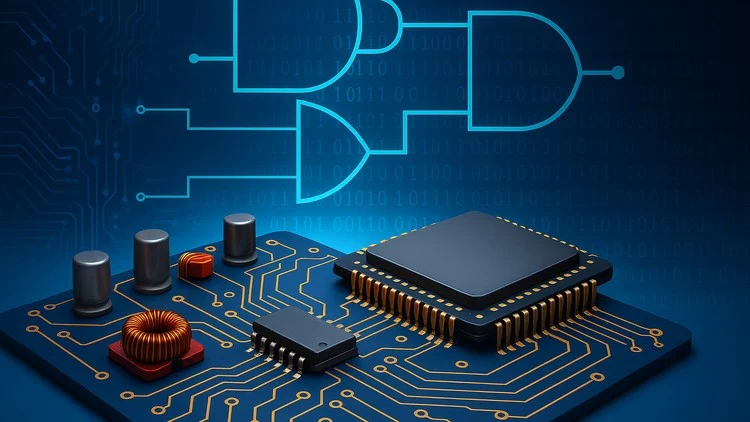
Master the bridge between physical silicon and executable code. This course delivers a professional-grade analysis of computer architecture, digital logic, and systems engineering. From the physics of MOSFET transistors and logic gates to CPU arithmetic and memory management, you will gain total visibility into the machine. Transition from hardware theory to practical reverse engineering using Ghidra and Assembly language analysis. Whether you are optimizing for performance or security, this is the definitive foundation for low-level computing and hardware-software integration.
Operator Profile
Target Audience
- Aspiring software engineers who want a complete foundational education.
- Cybersecurity enthusiasts who need to understand systems at the hardware/software level.
- Programmers who want to transition from high-level to low-level systems programming.
- Students tired of theoretical university programs who want real, practical skills.
- Tech entrepreneurs or CTOs who need a deep understanding of how computers work.
Objectives
What I will learn?
- Understand how computers and operating systems actually work from the hardware level up.
- Learn low-level programming languages like Assembly and C for full control over machines.
- Master the fundamentals of Computer Architecture, Memory, CPU, and I/O Systems.
- Build a strong foundation in Algorithms and Data Structures.
- Gain deep insight into Networking, TCP/IP, and how the Internet functions.
- Understand how compilers, interpreters, and binary systems operate.
- Write your own operating system components from scratch.
- Develop problem-solving skills used by professional computer scientists.
- Acquire practical knowledge applicable to real-world engineering jobs.
- Become prepared for advanced fields like Cybersecurity, Embedded Systems, and AI.
Recommended PRE-REQUISITE
Requirements
- A computer capable of running basic programming environments.
- Willingness to learn, think deeply, and practice regularly.
- No prior programming knowledge is required but basic computer literacy is helpful.
- You do not need a university background — this course covers it all from the ground up.
Module Skill level
All Levels
EXCLUSIVE RESOURCES |
Integrated Logic Schematics
Clinical-grade circuit diagrams bridging the gap between theoretical Boolean logic and physical CPU transistor implementation.
Ghidra Analysis Profiles
Professional-tier configuration files for Ghidra, optimized for rapid binary analysis and clean assembly disassembly.
Assembly Logic Workbooks
Comprehensive guides for mastering x86/ARM registers, memory addressing, and instruction set architecture.
Hardware Instruction Blueprints
Technical documentation on the physical execution of arithmetic operations within the CPU and volatile memory.
EXCLUSIVE RESOURCES |
Integrated Logic Schematics
Clinical-grade circuit diagrams bridging the gap between theoretical Boolean logic and physical CPU transistor implementation.
Ghidra Analysis Profiles
Professional-tier configuration files for Ghidra, optimized for rapid binary analysis and clean assembly disassembly.
Assembly Logic Workbooks
Comprehensive guides for mastering x86/ARM registers, memory addressing, and instruction set architecture.
Hardware Instruction Blueprints
Technical documentation on the physical execution of arithmetic operations within the CPU and volatile memory.
$19.00
$89.00
-
LevelAll Levels
-
Duration15 hours 30 minutes
-
Last UpdatedFebruary 7, 2026
-
CertificateCertificate of completion
Hi, Welcome back!
Course Curriculum
Introduction to Computers and Their Working Process
This section provides a fundamental introduction to computers, focusing on how they function at a basic level. You will explore the core components of computer systems, how these components communicate, and how computers process instructions to perform tasks. This knowledge forms the essential groundwork for understanding more advanced computer science concepts later in the course.
-
04:32
-
18:16
-
What Happens When You Use a Computer
17:00
Computer Arithmetic 101
This section focuses on how computers perform basic arithmetic operations at the hardware level. You will learn how addition and subtraction are handled within digital systems, including both unsigned and signed integers. This section explains the principles behind binary arithmetic, the handling of decimal numbers, and how computers interpret and process these operations within the CPU and memory.
-
How Addition Happens in Decimal
07:00 -
Addition Arithmetic in Unsignet Integers
08:00 -
Substraction in Decimal
09:00 -
Substraction Arithmetic in Unsigned Integers
05:00 -
Substraction Arithmetic in Signed Integers
08:00
Boolean Algebra 101
In this section, you will learn the fundamentals of Boolean Algebra, which is the mathematical foundation of digital logic and computing. We will cover basic concepts such as AND, OR, NOT operations, truth tables, and how Boolean expressions are used to design and simplify digital circuits within computers.
-
Boolean Algebra for Low Level Computing
18:00
Computer Electronics 101
-
Introduction to Electronics for Hardware Engineers
09:00 -
Logic Gates and Their Hardware Implementation
14:02 -
Capacitors and Implementations on Circuits
15:30 -
Why Use Inductors on Motherboards
13:00 -
Power Consumption and Transistors
13:00 -
MOSFET Transistors
-
CMOS Switches in Modern CPUs
07:00
Combinational Logic Circuits
In this lecture, you will learn the fundamentals of combinational logic circuits and their role in digital systems. We will explore how these circuits process inputs to produce specific outputs without relying on memory, covering essential components such as adders, multiplexers, encoders, and decoders. This knowledge is key for understanding how digital hardware performs calculations and logical operations.
-
Introduction to Logic Circuits
11:30 -
Full Adders
-
NAND and NOR Gates
15:00
Introduction to Ghidra
-
Understanding How Ghidra Works and Other Important Steps
12:30 -
Ghidra Analyzers and User Interface
13:00 -
Customizing Ghidra and Graphs
09:30 -
Getting Familiar with Ghidra Top Menu Bar
09:00
Introduction to Low Level Computing
In this lecture, you will learn the fundamentals of low-level computing, including how software interacts directly with hardware through machine code and assembly language. We will cover the relationship between hardware components and software instructions, laying the groundwork for understanding systems programming, embedded systems, and reverse engineering.
-
Introduction to Low Level Computing
14:00 -
From Characters to Bits
08:00 -
Creating Our Instruction Set Architecture CPU
27:30
Introduction to Reverse Engineering
In this lecture, you will learn the fundamentals of reverse engineering, including its purpose, techniques, and tools used in analyzing software and hardware systems. We will cover the core concepts behind understanding compiled programs, extracting useful information, and identifying vulnerabilities through structured analysis.
-
Reverse Engineering & Malware Analysis
08:40 -
5 Important Steps in Reverse Engineering and Malware Analysis
10:30 -
Virtualization Environment for Our Work
-
Using Built-in Tools for System Analysis
15:30
Assembly Language
In this lecture, you will learn the fundamentals of assembly language and its role in low-level computing. We will cover how assembly language interacts directly with hardware, how instructions are structured, and how understanding assembly is essential for reverse engineering, debugging, and systems programming.
-
Registers
12:30 -
Flags
12:30 -
Memory Addressing and Endianness
14:00 -
Read and Understand Assembly
07:00 -
Opcodes
05:30 -
Manipulating Memory
14:00
Second Part of Lecture : Advanced Topics in Low-Level Computing and Reverse Engineering
In this lecture, you will learn about the next steps beyond this course and what to expect in Part 2 of this training series. Part 2 will cover more advanced and practical applications of low-level computing, reverse engineering, and system analysis. It will also include further insights into real-world scenarios, advanced tools, and additional certification opportunities to solidify your skills and validate your expertise.
-
Certification
$19.00
$89.00
-
LevelAll Levels
-
Duration15 hours 30 minutes
-
Last UpdatedFebruary 7, 2026
-
CertificateCertificate of completion