On this page
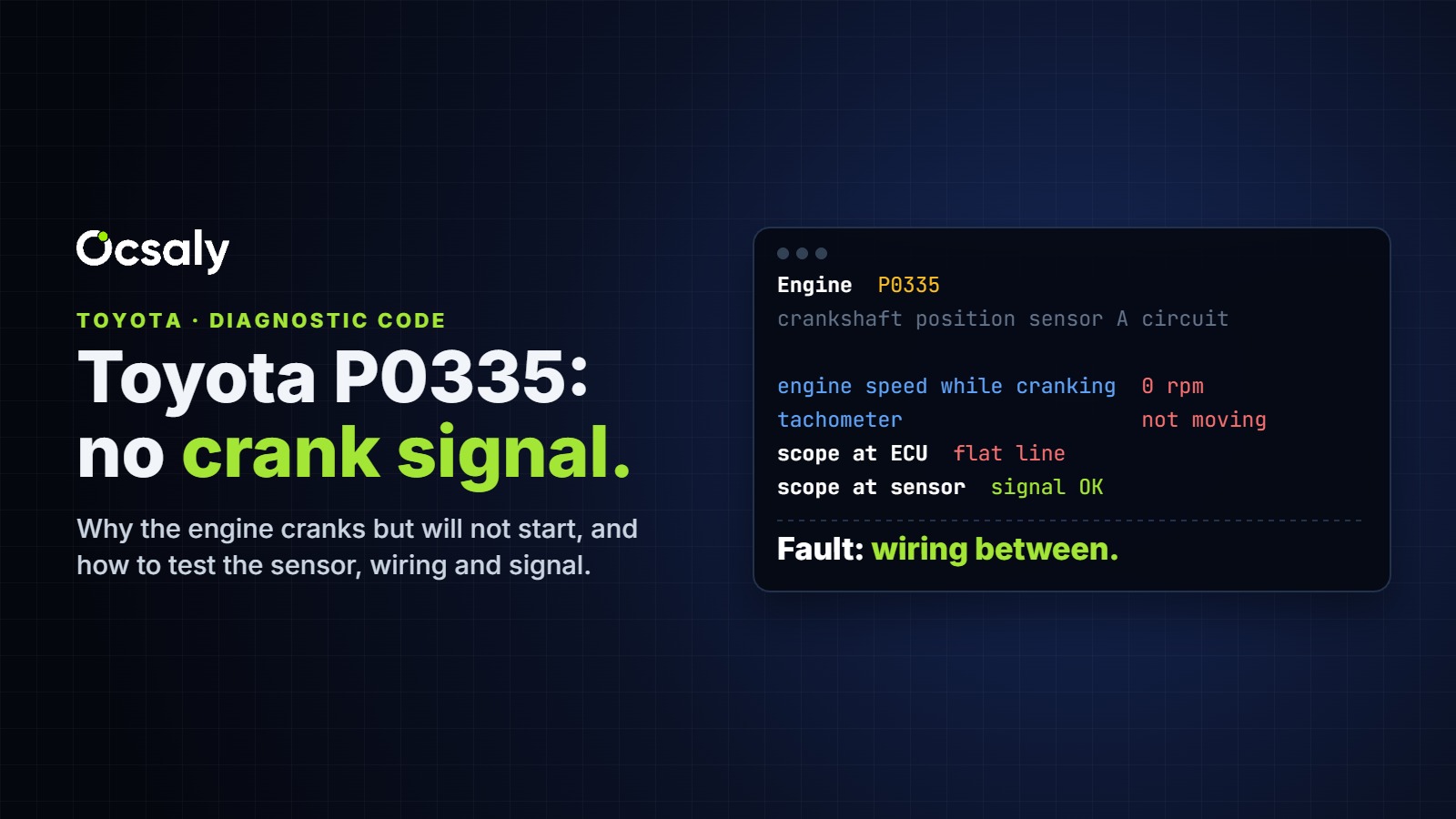
P0335 means “Crankshaft position sensor A circuit”. The engine computer did not receive a usable signal from the crankshaft position (CKP) sensor, which tells it engine speed and piston position. Without it the computer cannot time fuel injection and ignition, so the typical symptoms are an engine that cranks but will not start or stalls while driving, often with a tachometer that does not move while cranking. Common causes on Toyotas are a failed sensor, damaged wiring or connector (rubbed, oil-soaked or corroded), a damaged timing rotor (the toothed wheel the sensor reads), or debris on a magnetic sensor tip. Test the sensor’s signal at the sensor and at the engine computer before replacing parts.
How the crankshaft sensor works
Toyota engines use one of two sensor types, depending on the engine and year:
- Inductive (pickup coil, two wires): produces an AC voltage as the teeth pass. Amplitude and frequency rise with engine speed.
- Hall effect or magnetoresistive (three wires): powered by the engine computer and produces a square-wave signal.
The timing rotor has one or more missing teeth so the computer can identify the crankshaft’s position. P0335 is set when the signal is missing, or does not match what the computer expects, for long enough.
Symptoms
- Engine cranks but does not start
- Engine stalls while driving and may restart after cooling down (a typical sign of a failing sensor)
- Tachometer stays at zero while cranking
- Misfires, hesitation or rough running if the signal is intermittent
- Check engine light
Common causes
| Cause | Clue |
|---|---|
| Failed sensor | Signal missing at the sensor itself, often worse when hot |
| Damaged wiring or connector | Signal good at the sensor but not at the engine computer |
| Oil in the connector (leaking seals) | Oily connector, intermittent fault |
| Metal debris on a magnetic sensor tip | Weak or noisy signal |
| Damaged timing rotor or wrong gap | Irregular pattern on the scope |
| Shorted 5 V supply (three-wire sensors) | Other sensors on the same supply also fail |
How to diagnose P0335 step by step
- Read codes and live engine speed while cranking. If the scan tool shows 0 rpm while the engine turns, the computer is not getting the signal.
- Inspect the sensor and connector. Look for oil, corrosion, rubbed wires and loose pins. Remove the sensor and check its tip for metal debris and damage.
- For an inductive sensor: measure its resistance (compare with the specification for your engine) and its AC voltage while cranking. An open or shorted coil, or no AC output, means a bad sensor.
- For a three-wire sensor: with the ignition on, check the supply voltage and ground at the connector, then check the signal wire.
- Scope the signal at the sensor and at the engine computer connector while cranking. A good signal at the sensor and a bad one at the computer points to the wiring in between. A clean signal with irregular gaps points to the timing rotor.
- Check the wiring between sensor and computer for continuity and shorts to ground or power, with the battery disconnected for resistance tests.
- Replace the sensor with the correct part and clear the code. On some engines the computer relearns crankshaft variation after a sensor replacement.
How to read the waveforms is shown in the automotive oscilloscope guide, and how to trace the wiring in How to Read Car Wiring Diagrams.
Frequently asked questions
What does P0335 mean on a Toyota?
“Crankshaft position sensor A circuit”: the engine computer is not receiving a usable signal from the crankshaft position sensor.
Will a Toyota start with P0335?
Often it will not, because the engine computer needs the crankshaft signal to time fuel and ignition. If the fault is intermittent, the engine may run and then stall.
Can bad wiring cause P0335?
Yes. Rubbed, oil-soaked or corroded wiring and connectors cause many P0335 codes. Compare the signal at the sensor and at the engine computer to find out.
Why does my car stall when hot and restart when cold?
A failing crankshaft sensor often stops working when it gets hot and recovers as it cools. It is one of the classic signs of this fault.
Learn to test sensors the right way
Our Car Electronics & Car Hacking course teaches how sensors work, how to test them with a multimeter and oscilloscope, and how to trace wiring faults quickly.