On this page
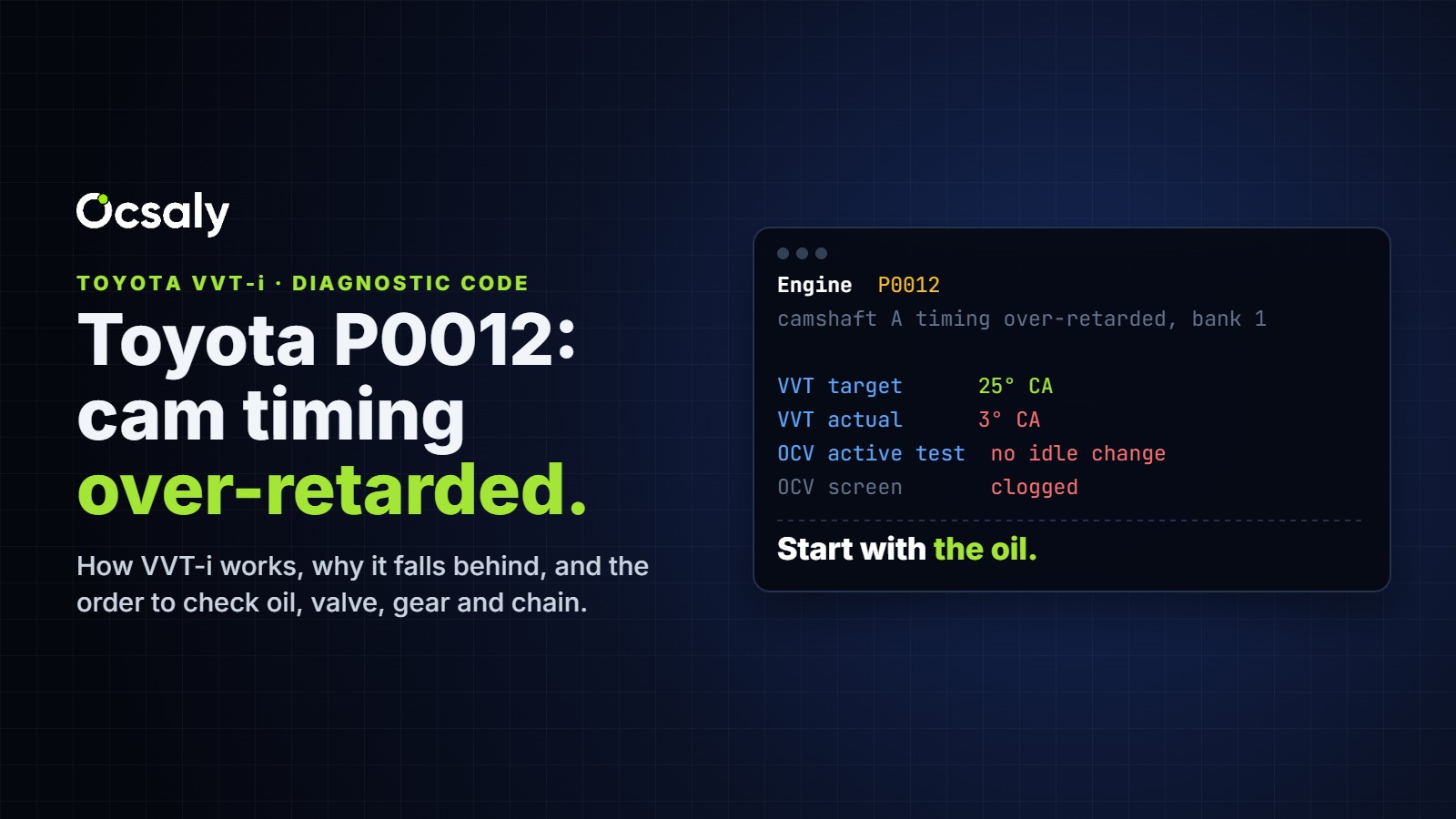
P0012 means “Camshaft position A timing over-retarded, bank 1”. On Toyota engines with VVT-i, the engine computer moves the intake camshaft timing with engine oil pressure, using an oil control valve (OCV) and a VVT gear (cam phaser) on the camshaft. P0012 says the actual cam timing stayed later (more retarded) than commanded for too long. The usual causes, in order of likelihood: low or dirty oil (or the wrong viscosity), a sticking OCV or a clogged OCV filter screen, a faulty VVT gear, and on high-mileage engines a stretched or jumped timing chain. Start with the oil and the OCV before considering bigger repairs.
How VVT-i works
The VVT gear on the intake camshaft has chambers filled with engine oil. The OCV, a solenoid valve controlled by the engine computer, sends oil to one side or the other to advance or retard the camshaft relative to the crankshaft. The computer compares the cam and crank sensor signals to calculate the actual timing and adjusts the OCV until it matches the target. If the camshaft cannot reach the target because oil does not get through, the valve sticks, or the gear is worn, the timing lags and P0012 (or P0011, over-advanced) is stored.
Symptoms
- Check engine light
- Rough or unstable idle, sometimes stalling when coming to a stop
- Reduced power and economy
- Rattle at start-up on some engines (worn VVT gear or chain)
Common causes
| Cause | Clue |
|---|---|
| Low oil level, old or sludged oil, wrong viscosity | Oil overdue or dark and thick; the code may clear after an oil change |
| Sticking oil control valve | No idle change during the OCV active test |
| Clogged OCV filter screen (on engines that have one) | Debris in the small screen near the OCV port |
| OCV electrical fault | Coil resistance out of spec, wiring fault (usually sets a circuit code too) |
| Faulty VVT gear (cam phaser) | Rattle at start, timing does not move even with a good OCV |
| Stretched or jumped timing chain | High mileage, cam/crank correlation codes, timing marks out |
How to diagnose P0012 step by step
- Check the oil level and condition. If it is low, dark or overdue, change it with the correct grade and filter and clear the code. VVT systems depend on clean oil at the right pressure.
- Watch live data: VVT target and actual angle (or advance) at idle and when you raise the engine speed. A large gap that does not close confirms the code is real.
- Run the OCV active test with a scan tool that supports Toyota. Commanding the OCV on at idle should make the idle rough or stall the engine; if nothing changes, the valve, its oil supply or the gear is not responding.
- Check the OCV electrically. Measure the coil resistance against the specification for your engine (usually a few ohms) and check the wiring to the engine computer.
- Remove and inspect the OCV. Look for sludge and a stuck spool, and clean or replace the filter screen if your engine has one.
- Check cam/crank correlation with a scope or the timing marks if the above are good. A stretched chain or a jumped tooth shifts the timing permanently and often sets correlation codes as well.
- Replace the VVT gear only after the oil, OCV and timing are confirmed good.
Frequently asked questions
What does P0012 mean on a Toyota?
The intake camshaft timing stayed more retarded than the engine computer commanded. The VVT-i system could not advance the camshaft to its target.
Can an oil change fix P0012?
Often it can. Low, old or wrong-viscosity oil is a common cause because VVT-i moves the camshaft with oil pressure. Change the oil and filter, clear the code and see if it returns.
Is P0012 serious?
It is not usually an emergency, but it reduces performance and economy, and if the cause is sludge or a stretched chain, ignoring it can lead to expensive engine damage.
What is the difference between P0011 and P0012?
P0011 means the camshaft timing is over-advanced; P0012 means it is over-retarded. Both are bank 1, intake camshaft (“A”) faults.
Learn sensors and actuators properly
VVT systems are a good example of how sensors, actuators and the engine computer work together. Our Car Electronics & Car Hacking course covers reading live data and testing sensors, actuators and wiring, and the automotive oscilloscope guide shows how to check cam and crank signals.