On this page
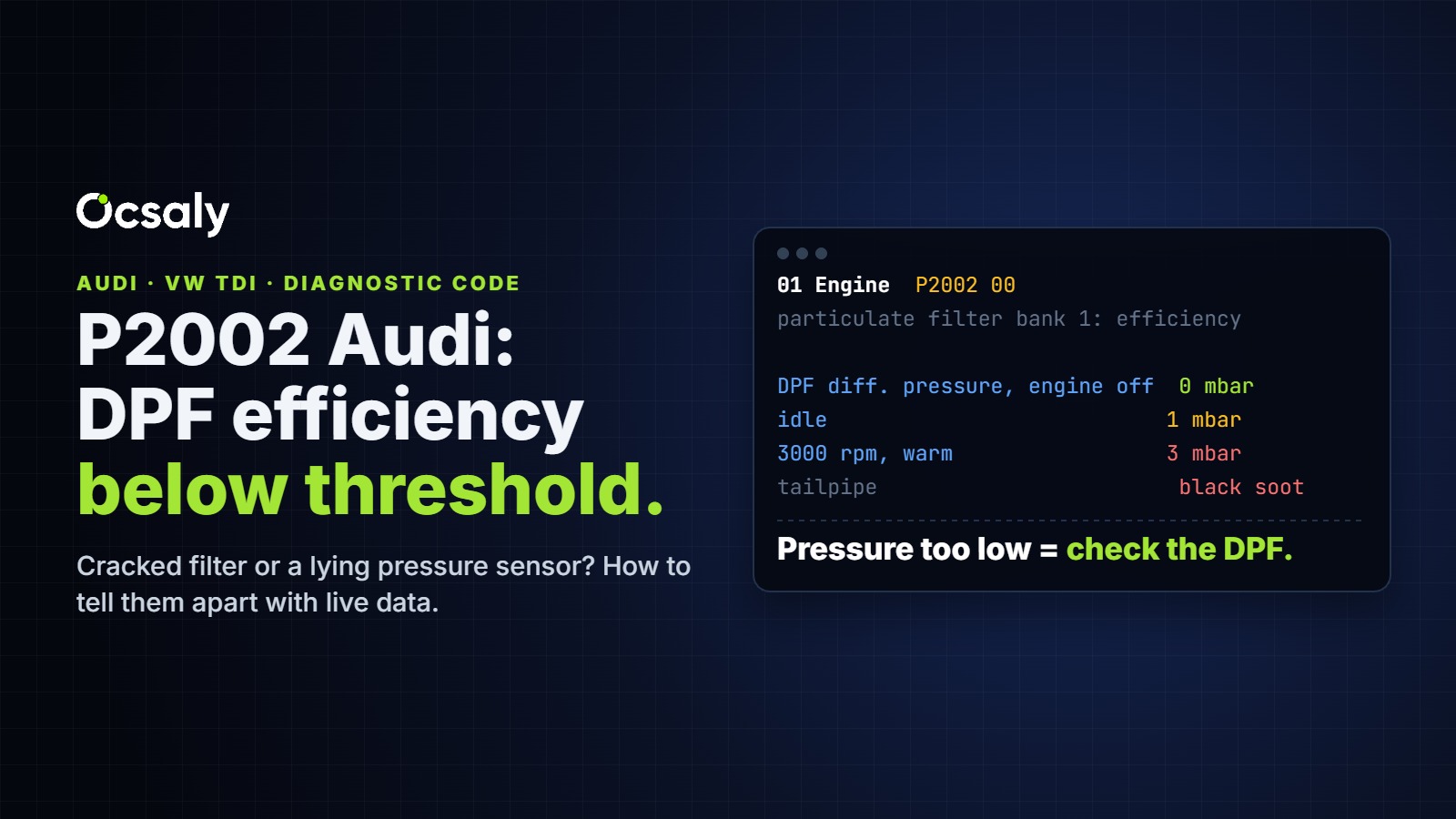
P2002 means “Diesel particulate filter efficiency below threshold, bank 1”. On Audi, VW, Seat and Skoda TDI engines the engine computer judges the particulate filter (DPF) by the pressure difference across it, measured by the differential pressure sensor through two small hoses. When that difference is too low for the exhaust flow, the computer concludes that exhaust is passing through the filter without being filtered, which happens with a cracked or broken DPF, but just as often with a leaking, split or swapped sensor hose or a faulty pressure sensor. Diagnose it by checking the hoses and sensor first and then comparing the live differential pressure at idle and at higher engine speed with the specification.
What P2002 means
A working DPF creates a measurable back-pressure that rises with exhaust flow and with the amount of soot inside it. The engine computer knows how much exhaust is flowing, so it knows roughly what pressure difference to expect. If the measured difference stays too low, the filter is not doing its job, or the measurement is wrong.
Do not confuse it with the codes for the opposite problem:
| Code | Meaning | Typical direction |
|---|---|---|
| P2002 | DPF efficiency below threshold | Pressure difference too low (filter cracked, or the sensor or its hoses read too low) |
| P2463 | DPF soot accumulation | Filter too full, regeneration needed |
| P2452 to P2455 | DPF differential pressure sensor circuit, range, low or high | Electrical or plausibility fault of the sensor itself |
Symptoms
- Engine warning light, sometimes the DPF warning light
- Usually no obvious drop in power at first
- On a cracked filter: black soot inside the tailpipe of a car whose tailpipe should stay clean, and sometimes visible smoke under acceleration
- Regenerations that start too rarely or never, because the computer believes the filter is empty
Common causes
- Sensor hoses: cracked, melted, disconnected, blocked with soot or condensation, or connected the wrong way round after a repair. This is the cheapest and one of the most common causes.
- Faulty differential pressure sensor: a sensor that reads too low.
- Cracked or melted DPF substrate: often after an uncontrolled regeneration or a long period of running with an over-full filter.
- Exhaust leaks before the filter or around the sensor pipes.
- A removed or hollowed-out DPF. Besides the code, this is illegal for road use in the EU, the UK, the US and many other countries, and fails emission tests.
How to diagnose P2002 step by step
You need a scan tool that shows live engine data for VAG cars (VCDS, OBDeleven, ODIS or a good multi-brand tool).
- Read all codes and the freeze frame. Note mileage, temperature and engine speed when the code was set, and any other engine or exhaust codes.
- Inspect the sensor hoses from the DPF to the sensor along their whole length. Check for splits, melted sections near the exhaust, blockages and loose clips. Confirm they are on the correct ports (the pipe from before the filter goes to the sensor’s high-pressure port, usually marked).
- Check the sensor reading with the engine off. The differential pressure should read about zero. A clear offset suggests a faulty sensor.
- Compare live pressure at idle and at about 3000 rpm with a warm engine. On a healthy system the value rises clearly with engine speed. If it barely changes, either the hoses or sensor are not seeing the pressure, or the filter has no restriction left. Compare with the specification for your engine in the repair information.
- Look in the tailpipe. A dry, clean tailpipe on a DPF car is normal; fresh black soot points to a damaged filter or a leak.
- Check for exhaust leaks at the DPF joints and the sensor pipe connections.
- Only then replace the DPF. After fitting a new filter, the engine computer must be told with a scan tool (an adaptation or basic setting for a new particulate filter) so it resets its soot and ash model.
Can you drive with P2002?
Usually yes for a short time, but a cracked DPF lets soot into the air, the car will fail an emissions test, and the computer may stop regenerating correctly. Fix it soon. If P2002 appears together with codes for an over-full filter, stop forcing regenerations until the cause is found, because uncontrolled regeneration of an overloaded filter is one way filters crack.
Frequently asked questions
What does P2002 mean on an Audi?
“Diesel particulate filter efficiency below threshold, bank 1”: the pressure difference across the DPF is lower than expected, so either the filter is damaged or the differential pressure measurement is wrong.
Can a bad DPF pressure sensor cause P2002?
Yes. A sensor that reads too low, or split, blocked or swapped hoses to it, can set P2002 even when the filter is fine. Check them before replacing the DPF.
Will a forced regeneration fix P2002?
Not usually. P2002 is about the filter not filtering, not about it being too full. Regeneration is for soot accumulation codes such as P2463.
Is it legal to remove the DPF instead?
In the EU, the UK, the US and many other countries it is illegal to remove or disable the DPF on a road vehicle, and the car will fail emissions testing. Repair or replace the filter.
Do I need to code a new DPF on an Audi?
Yes. After replacing the filter, run the adaptation for a new particulate filter with a VAG-capable scan tool so the engine computer resets its soot and ash calculations.
Diagnose with data, not guesses
Reading live data, understanding what each sensor measures and testing wiring and sensors properly are core skills in our Car Electronics & Car Hacking course. For network and module codes on VAG cars, see U111300 explained.